some polymers are formed from the reaction of 2 diff. types of monomers
- these polymers are formed by condensation polymerisation
Definition
Condensation polymerisation occurs when monomers combine to form condensation polymers, with the removal of small molecules such as water #ChemistryDefinitions
2 types of condensation polymers:
- polyester
- polyamides
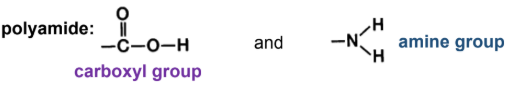
Polyester: alcohol (diol) + carboxylic acid (dicarboxylic acid) Polyamide: amine (diamine) + carboxylic acid (dicarboxylic acid) must have functional groups at both ends.
Note
type of condensation polymer formed depends on functional groups in the monomers which took part in the condensation polymerisation.
Functional group of monomers that form the condensation polymers:
i)
ii)

Examples
Nylon - Synthetic Polyamide Terylene - Synthetic Polyester
Uses of Synthetic Fibres
nylon and terylene are synthetic fibres.
- clothing, curtains, parachutes, fishing lines, sleeping bags.
synthetic fibres → usually strong → can be drawn into thin strands without breaking.
- can be used to make fishing lines
Clothes made from synthetic fibres are shrink proof + cease proof.
- also easier to wash and dry
tent and sleeping bag made from terylene. unlike natural fibres, synthetic fibres do not shrink when exposed to water.
Deduce Structure of Condensation Polymer Product from Given Monomers
Deduce Structure of Condensation Polymer Product from Given Monomers
Deduce Structural Formula of Monomers from Given Condensation Polymer
Deduce Structural Formula of Monomers from Given Condensation Polymer