Group Properties - Group 1 Elements (Alkali Metals)
Physical Properties
- Shiny (or lustrous) and silver solid
- Good conductors of heat and electricity
- soft and can be cut easily (these elements are softer than most other metals)
- low melting and boiling points (unlike other common metals → like iron and copper which have much higher melting and boiling points)
- Low density and first three group 1 elements → will float on water. (unlike transition metals like iron and copper → which have much higher densities than group I metals and water, thus sink in water)
Going down the group → from lithium to francium → trends are observed in the physical properties of alkali metals
- Melting and boiling points of alkali metals decreases
| Element | Melting point ( ) | Boiling Point () |
|---|---|---|
| lithium | 181 | 1342 |
| sodium | 98 | 883 |
| potassium | 64 | 760 |
| rubidium | 39 | 686 |
| caesium | 28 | 671 |
- Densities of alkali metals increases
- potassium:
- rubidium:
- caesium:
Chemical Properties
Alkali metals → very reactive. → thus they must be stored in oil to prevent them from reacting with oxygen in air and water.
Sample
Using atomic structure → suggest why alkali metals are highly reactive
- Atoms of these elements have 1 valence electrons {1}
- When group 1 elements react, their atoms lose their valence electrons very readily to form positively charged ions which have stable electronic configuration. Very little energy is required to lose that 1 valence electron to form cation with stable electronic configuration {1}
- Thus these elements are highly reactive.
Group 1 elements → being highly reactive metals → are powerful reducing agents → in the redox reactions listed below
- in these reactions → group 1 elements → formed ions with a charge of 1+
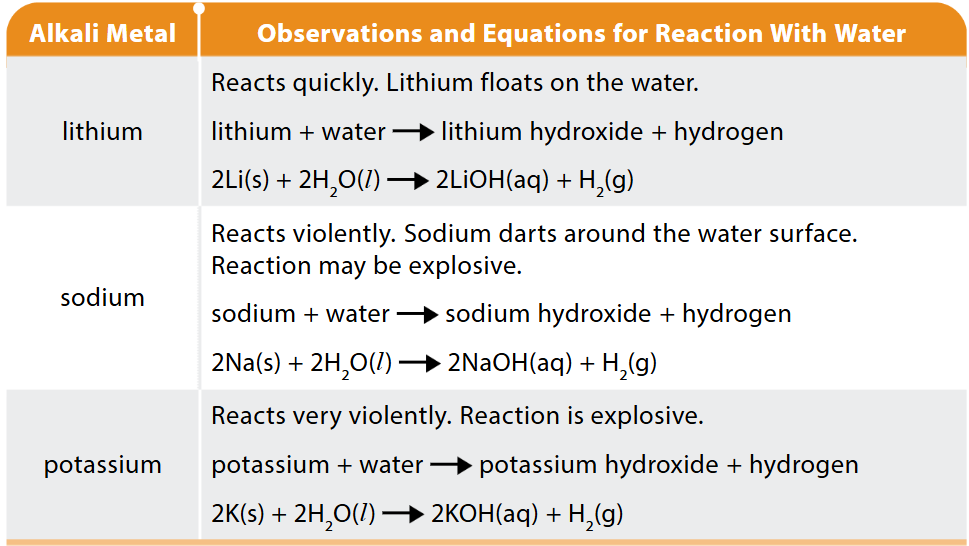
- Group 1 metals react with water to form soluble metal hydroxide and hydrogen gas
- (M is the symbol for group 1 metals)
-
Group 1 metals react with steam to form metal oxide and hydrogen gas (displacement reaction)
-
Group 1 metals react with dilute acid to form → salt + hydrogen gas (displacement reaction)
Going Down the group → from lithium to francium → a trend is observed in the chemical properties of alkali metals
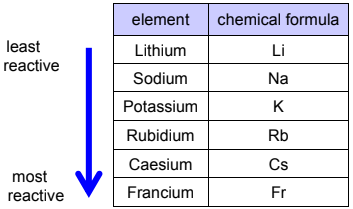
- reactivity of group 1 metals increases down the group.
- lithium does not burn when reacted with water, sodium may or may not burn when reacting with water, potassium burns when reacting with water
Sample
Based on the trend in reactivity of alkali metals, one can predict what will be observed when caesium is added to water
- violent reaction between caesium and water which is highly explosive
Sample
Using Electronic structures, explain the trend in the reactivity of alkali metals
- Reactivity of alkali metals increases down the group {1}
- Down the group → atomic size (atomic radius) → increases due to increasing number of electron shells thus forces of attraction between negatively charged valence electron and the positively charged nucleus decreases. {1}
- Hence it is easier for metal atom to lose valence electron to form positively charged ion {1}
Note
Order of Reactivity Lithium < Sodium < Potassium < Rubidium < Caesium < Francium