- E.g. for molten sodium chloride
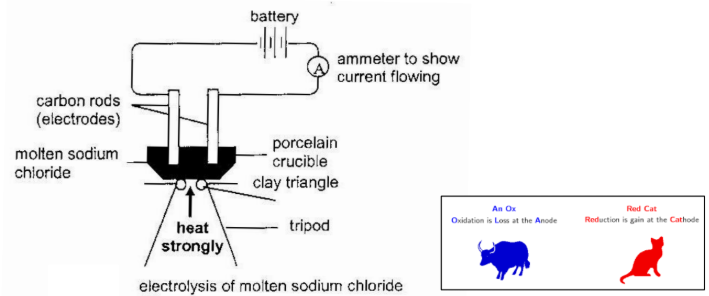
- Why must electrolyte be heated strongly throughout process of electrolysis
- Only when electrolyte → is molten/aqueous solution → can ions move freely throughout substance and migrate to oppositely charged electrodes and electrolysis can take place
- Sodium chloride → ionic compound → has high melting point. At r.t.p → sodium chloride is in solid state. Thus → large amount of heat has to be provided → to overcome strong electrostatic forces of attraction → which hold the sodium and chloride ions → in fixed positions → in the giant ionic lattice structure to melt this substance. Properties of Ionic Compounds
- Only when substance has melted → it must be heated continuously → to ensure → that temperature remains above → melting point → for electrolysis to take place continuously
- If heating stops → temperature of sodium chloride → will eventually decrease → until sodium chloride solidifies → and electrolysis will no longer take place → ions can no longer move freely and be attracted to oppositely charged electrodes.
- Which ion will migrate to positive electrode?
- Chloride ion (opp. charges attract, thus positive electrode → which is anode → attract negative ions which are anions)
- Describe what Happened to ions at positive electrode
- chloride ions → are discharged → as they undergo oxidation → by losing electrons → to form (or chlorine molecules)
Note
Term ‘discharged’ means undergo reaction → resulting in charge being removed.
- equation for reaction which takes place at positive electrode. include state symbols
- describe what was observed at the positive electrode during electrolysis
- pale yellow-green gas → evolved → around anode during electrolysis (chlorine, found in Group Properties - Group 17 Elements (Halogens))
- which ion will migrate to negative electrode
- Sodium Ion,
- Describe what happened to the ions at the negative electrode
- will gain electron, and undergo reduction to form sodium.
- write an equation for the reaction which takes place at the negative electrode. include state symbols
- describe what was observed at negative electrode during electrolysis
- tiny globules of molten sodium float to surface of molten sodium chloride (1)
- sodium burns in air with flashes of yellow light (1) (no need to identify as sodium, for colour → Group Properties - Group 1 Elements (Alkali Metals))
- write overall equation for electrolysis of molten sodium chloride. include state symbols