- usually temperature of reactants → that are aqueous solutions
At higher temperatures, rate of reaction is affected in 2 ways:
- At higher temperature → reactant particles have more kinetic energy. This means that they move and vibrate faster → increasing frequency of effective collisions
- At higher temperature → more reactant particles possess energy that is greater than or equal to activation energy. This increases frequency of effective collisions.

Example
Sodium Thiosulfate + Hydrochloric acid → Sodium Chloride + Water + Sulfur Dioxide + Sulfur
Yellow precipitate of sulfur is produced. this reduces amount of light passing through the solution. hence we can find ROR by measuring time taken for the solution to turn opaque.
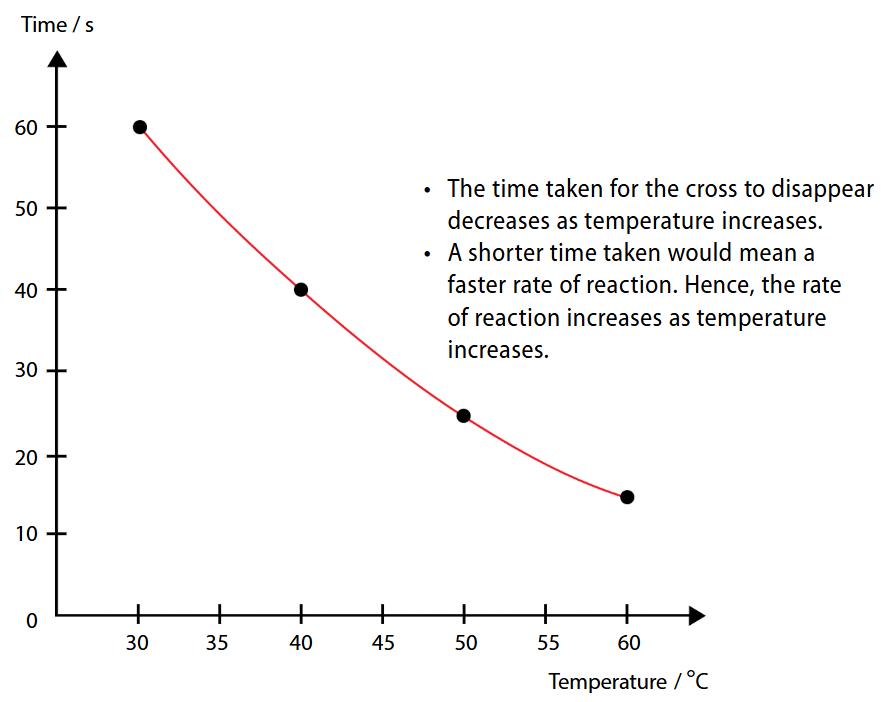
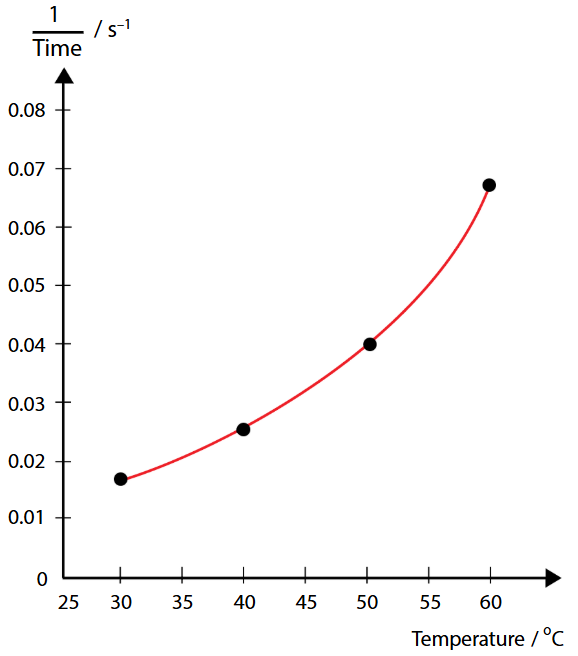
- Rate of reaction is inversely proportional to the time taken for the cross to disappear.
by plotting graph of against temperature → we can directly observe how rate of reaction varies with temperature.
Sample
Rate of Reaction increases with an increase in temperature
- reacting particles gain more kinetic energy, move faster and collide with each other more often per unit time and collide with more energy
- more reacting particles have energy equal to or greater than the activation energy
- thus frequency of effective collision increases
- hence rate of reaction increases
Sample
Rate of reaction decreases with a decrease in temperature
- reacting particles of the reactants have lesser kinetic energy, move slower and collide with each other less often per unit time, and collide with less energy
- fewer reacting particles have energy equal to or greater than the activation energy
- thus frequency of effective collision decreases
- hence rate of reaction decreases
Real Example Example effect of using hot HCl on ROR between acid and sodium thiosulfate solution.
- at higher temp, the reacting particles (of hydrochloric acid and sodium thiosulfate solution or H+ ions and thiosulfate ions) have more kinetic energy, move faster and collide with each other more often per unit time and also collide with more energy
- more of these reacting particles will have energy equal to or greater than the activation energy
- thus frequency of effective collisions the reacting particles (of hydrochloric acid and sodium thiosulfate solution or H+ ions and thiosulfate ions) increases and the rate of reaction increases.
Summary
increase in temperature of reactants results in an increase in the rate of reaction