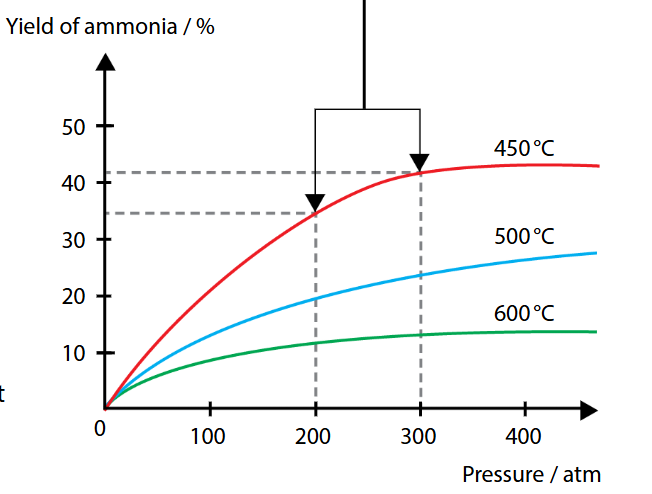
Effect of Pressure on Yield of Ammonia
- higher pressure leads to higher yield of ammonia. it also leads to a faster rate of reaction. Rate of Reactions Main Note
- however, maintaining a high pressure incurs a large cost. this is because it requires expensive equipment and large amount of electricity.
- hence, compromise pressure of 200atm is used.
Effect of Temperature on Yield of Ammonia
- lower temperature leads to higher yield of ammonia.
- this is because it reduces decomposition of ammonia
- however lower temperature would slow down the reaction
- hence, compromise temperature of 450 is used.
Purpose of Catalyst
- Reaction is slow despite using relatively high temperature and high pressure.
- hence, iron catalyst is added to speed up reaction
| Conditions | Reasons |
|---|---|
| 1. finely divided iron as catalyst | - increase rate of forward reaction, more ammonia gas will be produced over a shorter period of time → leading to more cost savings which is an economic advantage. - how does finely divided iron speed up rate of reaction? Catalysts and their Affect on ROR |
| 2. optimal temperature of | - if temp is too low → ROR will be very slow. Temperature at which Reaction Occurs - if temp is too high → backward reaction will be favoured. Thus, lot of produced will decompose to form and again. This causes percentage yield of to decrease |
| 3. optimal pressure of 250atm | - higher the pressure the faster the ROR. Pressure at which Reaction Occurs - if pressure is too high → operating cost for this pressure will be too high. Maintaining high pressure → requires expensive equipment like special pumps and stronger pipes. This is economic disadvantage of using pressure which is too high. |