Metals are found in the ground in metal ores.
Definition
Metal ore is a mixture of compound of metal (such as oxides, sulfides, chloride, carbonates) and a large amount of earth and rock.
- Metal ores are sources of metal compounds (such as metal oxides) → from which metals can be extracted.
- Metal ores also contain impurities → which are removed during or before extraction process
| Name of Ore | Name and formulae of compound present in ore | Metal to be extracted |
|---|---|---|
| Bauxite | Aluminium Oxide () | Aluminium |
| Haematite | Iron (III) oxide () | Iron |
| Copper Pyrite | Copper iron sulfide () | Copper |
| Zinc Blende | Zinc sulfide (ZnS) | Zinc |
| Extraction involves reduction of the metal compound to become the metal |
- We learnt before → compounds of reactive metals are more stable compared to compounds of less reactive metals.
- Hence more reactive metals are more difficult to extract and less reactive metals are easier to extract from their ores
Electrolysis ElectroChemistry Main Noteof molten compound/ores → used to extract more reactive metals.
| Metal | Method of Extraction |
|---|---|
| Potassium Sodium Calcium Magnesium Aluminium | Electrolysis of molten compound/ore |
| Zinc Iron Lead Copper | Heating ore with carbon to reduce metal oxide in ore |
| Silver | heating the ore alone |
| Gold Platinum | usually found naturally uncombined |
Note
- More reactive metals are extracted by the electrolysis of the molten ore/compound is used to extract them. Electrolysis decomposes the metal compound
- Moderately reactive metals (zinc to copper) → extracted by reduction of their compounds (metal oxides) with carbon. Heating is required
- For the least reactive metals, like silver → heating the ore alone (without need of carbon) is sufficient
Optional Case study: Extraction of iron from Haematite in Blast Furnace
Raw materials:
- Haematite - an iron ore → containing mainly iron (III) oxide
- Coke (a form of carbon)
- Limestone
Hot air is blasted into the blast furnace at the bottom
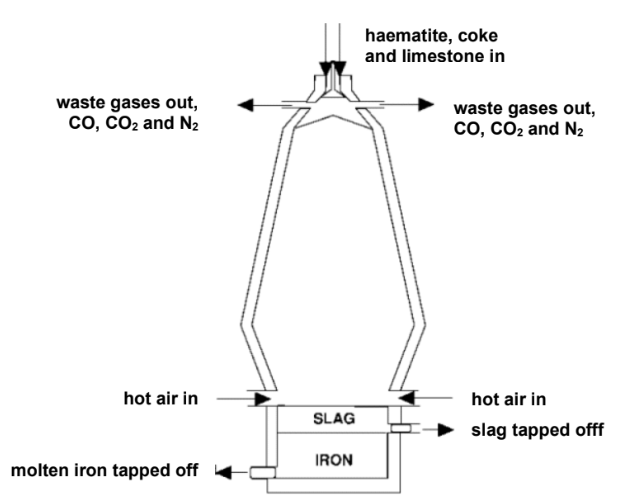 These processes occur inside the 1000 - 1500 degree Celsius blast furnace
Stage 1: Coke reacts with oxygen to form carbon dioxide
Stage 2: Carbon dioxide reacts with more coke to form carbon monoxide
Stage 3: Carbon monoxide reacts with iron (III) oxide to form iron and carbon dioxide gas
- Molten iron is removed at the bottom of the blast furnace
Removal of Impurities(mainly silicon dioxide, an acidic oxide) Using limestone
- Limestone decomposes to form lime (calcium oxide) and carbon dioxide
- Calcium reacts with the silicon dioxide (sand) to form calcium silicate, which is the molten slag
- Molten slag is hot and is removed near the bottom of the blast furnace
Waste gasses of carbon monoxide and carbon dioxide → given off. Unreacted nitrogen and sulfur dioxide (from sulfur impurities in coke) are also released\