Order of reactivity → of metals → can be used to explain observations made when following reactions of metals and their compounds take place:
- Reactions of metals with steam and cold water
- Reactions of metals with dilute acids
- Displacement reactions of metals
- Reactions of metals with aqueous solutions of salts (contains cations of metals)
- Reaction of metals with metal oxides
- Reactions of metal oxides with carbon
- Reactions of metal oxides with hydrogen gas
- Thermal decomposition reactions of metal carbonates
Note
In the reactivity series → metals are arranged from most reactive to least reactive
- Includes carbon and hydrogen → although they are not metals.
Definition
Define reactivity of Metals:
- Tendency of an atom of metal to lose one or more (valence) electron(s) to form its positive ion
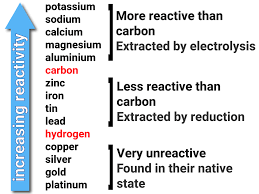
Relationship Between Reactivity of a metal and its strength as a reducing agent
-
The more reactive the metal → the greater the tendency for an atom of a metal to lose electron(s) to another reactant to form its positive ion and hence → greater the tendency for the metal to be oxidised. Hence a more reactive metal is a stronger reducing agent
-
The less reactive a metal → the lower the tendency for an atom of a metal to lose electron(s) to another reactant to form its positive ion and hence → lower the tendency for the metal to be oxidised. Hence less reactive metal is a weaker reducing agent. Link to Oxidation and Reduction Main Note
Metal + Steam/Water/Hydrochloric Acid
Metal + Water, Steam, Hydrochloric Acid
Chemical Properties of Metals and Their Compounds, Displacement Reactions
Chemical Properties of Metals and Their Compounds, Displacement Reactions
Reaction of metal oxides with carbon and hydrogen (redox reactions)
Reactions of Metal oxides with Carbon and Hydrogen (Redox Reactions)
Thermal Decomposition of Metal Carbonates
Thermal Decomposition of Metal Carbonates
Metal ores and Method of Extraction
Metal Ores and Method of Extraction
Rusting
Understanding
“More reactive metals have a lower ionization energy, meaning they require less energy to lose electrons and form cations compared to less reactive metals.” “This is because more reactive metals have a larger atomic radius and weaker attraction between the nucleus and the valence electron, making electron loss easier.”
Important
some questions ask for purpose of fuse: The ignition of the magnesium fuse provides sufficient amount of energy to start the reaction between the metal and the metal oxide.
Important
inverse r.s. between gain and loss
- more reactive → lose more readily and gain less readily
- less reactive → gain more readily and lose less readily
most (thermally) stable carbonate → most reactive metal