general equations:
- acid(aq) + alkali(aq) → salt(aq) + water(l)
- acid(aq) + soluble carbonate(aq) → soluble salt(aq) + water(l) + carbon dioxide(g) → soluble carbonates must be in aqueous solution.
in this method → both reactants used are soluble. if reactant is in excess → it cannot be removed from salt solution in filtration and salt produced will be impure. → therefore volume of each starting material used must be exact.
sodium, potassium, and ammonium salts → can be prepared using titration method.
what salts can be prepared using this method:
- soluble salts of group 1 metal salts and ammonium salts.
Purpose of Titration → is to find out the exact volume of acid/alkali needed to neutralize the alkali/acid → preparation part will still be crystallization.
condition:
- acid + alkali(aq) OR
- acid + aqueous group 1 carbonates/ammonium chloride
Physical state of reactants and products of reactions used in this method:
- Dilute acids: aqueous state
- Alkalis: aqueous state
- Soluble salts: aqueous state
- Water: liquid state
- Carbon dioxide gas: gaseous state.
| Example: describe how pure crystals of sodium nitrate can be prepared using a solution of sodium hydroxide and an acid |
|---|
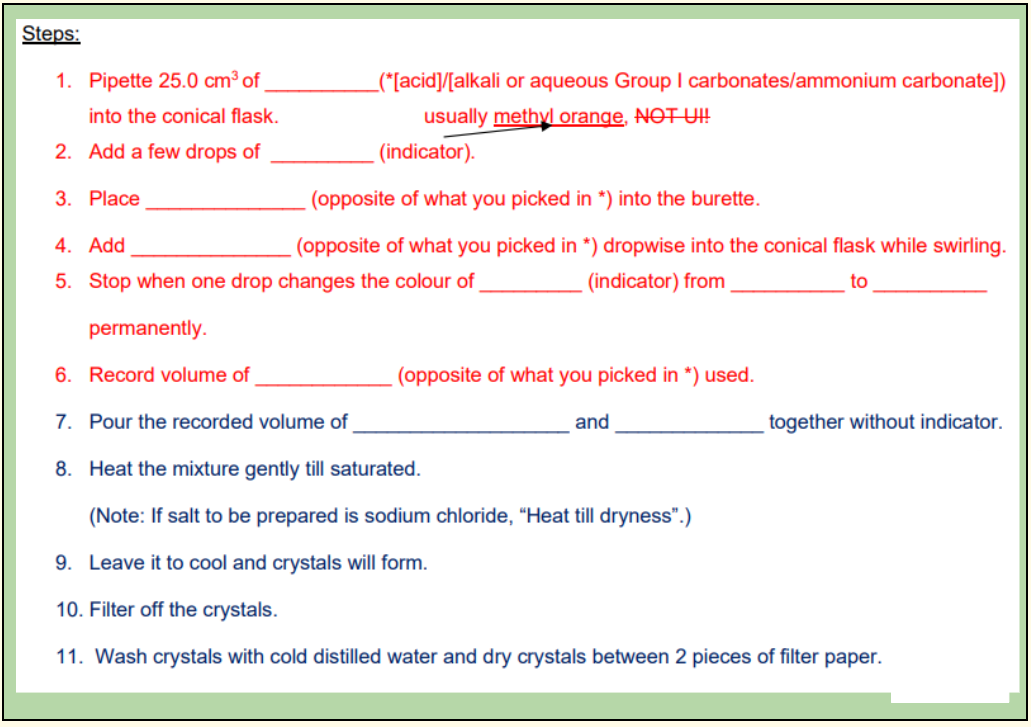
| 1. sodium nitrate can be prepared by reacting sodium hydroxide solution with dilute nitric acid. Pipette 25.0cm3 of sodium hydroxide solution into a conical flask. Add 3 drops of methyl orange solution(indicator) to the alkali in the conical flask. 2. using a burette, add dilute nitric acid dropwise into the conical flask until the indicator changes color which indicates that reaction is complete (methyl orange indicator changes color from yellow to orange) this is endpoint of titration. stop titration. 3.Record volume of dilute nitric acid used. this is the volume of dilute nitric acid used to neutralize the sodium hydroxide solution completely. 4. Pipette 25.0cm3 of sodium hydroxide solution into a beaker. Then add the recorded volume of dilute nitric acid from the burette to the beaker without adding methyl orange. The colorless solution obtained is sodium nitrate. 5. Heat the solution until saturation. Allow the saturated sodium nitrate solution to cool and crystallize. 6. Filter to collect sodium nitrate crystals. Rinse the crystals with a little cold, distilled water to remove impurities. Dry the crystals between a few sheets of filter paper. |
| must know word for word* |
Explain why burette is used to measure volume of dilute nitric acid in titration instead of using a measuring cylinder.
- Burette measures varied volumes of dilute nitric acid accurately. This is important to ensure that the salt solution produced using titration is not contaminated with excess reactant. Measuring the cylinder does not measure volume of solution accurately.
explain why pipette is used to measure the volume of sodium hydroxide solution in titration instead of using a measuring cylinder.
- Pipette measures a fixed volume of sodium hydroxide accurately. This is important to ensure that the salt solution produced using titration is not contaminated with excess reactant. Measuring cylinder does not measure the volume of the solution accurately.