**Volt** is SI unit for -> electromotive force (e.m.f.) and Potential difference (p.d.)
Definition
Electromotive force (e.m.f) of an electrical source → is the work done by source in driving a unit charge around a complete circuit #PhysicsDefinitions
Formulae
where E = e.m.f of electrical source (V) W = work done (J) Q = amount of charge (C)
Note
SI unit of e.m.f is volt (V). Its SI unit may also be written as J/C, but it is uncommon to do so
Cell Arrangement and E.m.f
e.m.f of electrical source → SCALAR quantity arrangement of electrical source → determines amt of e.m.f supplied to electrical components. Dry cells → be arranged in either series or parallel
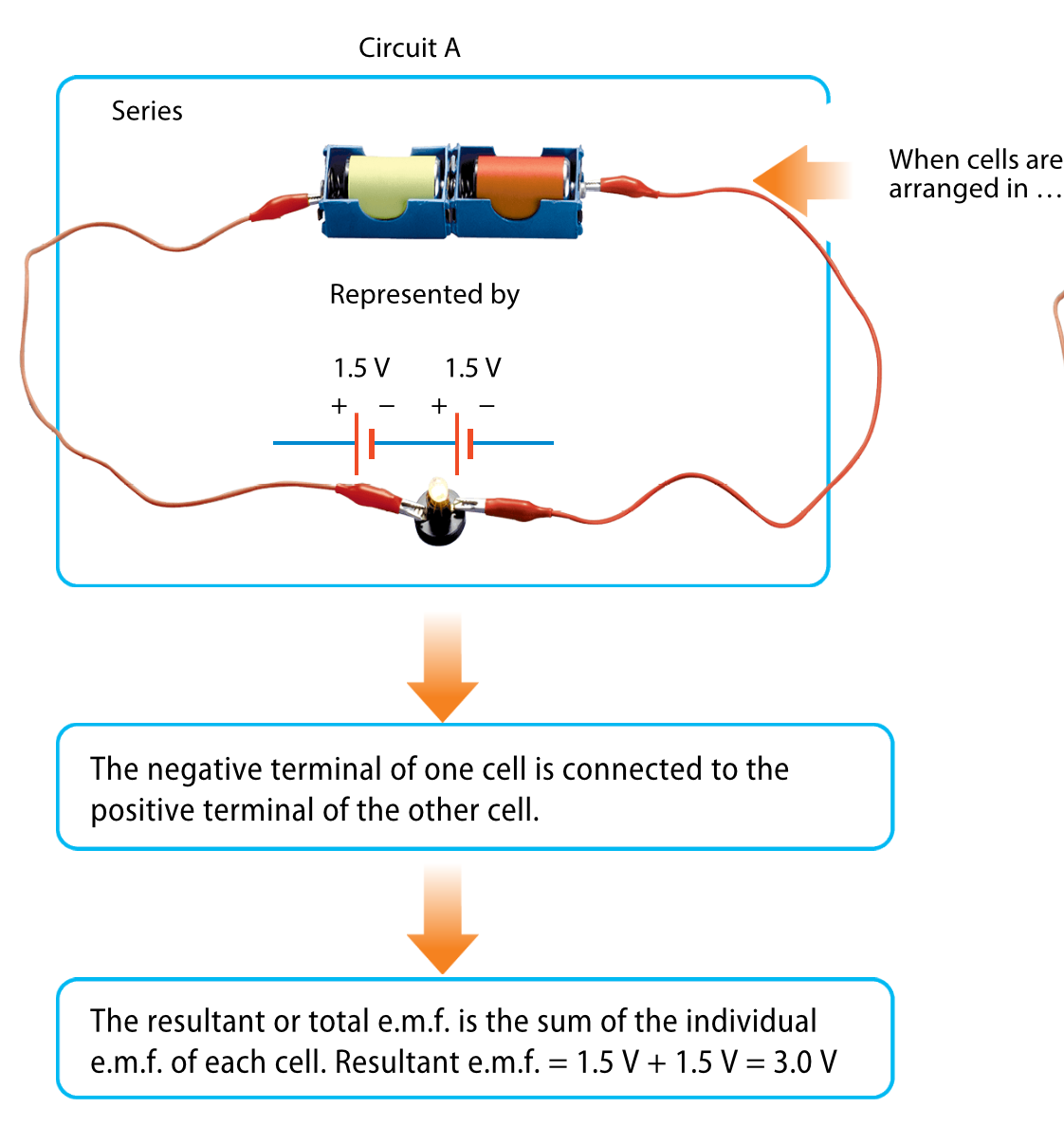 | 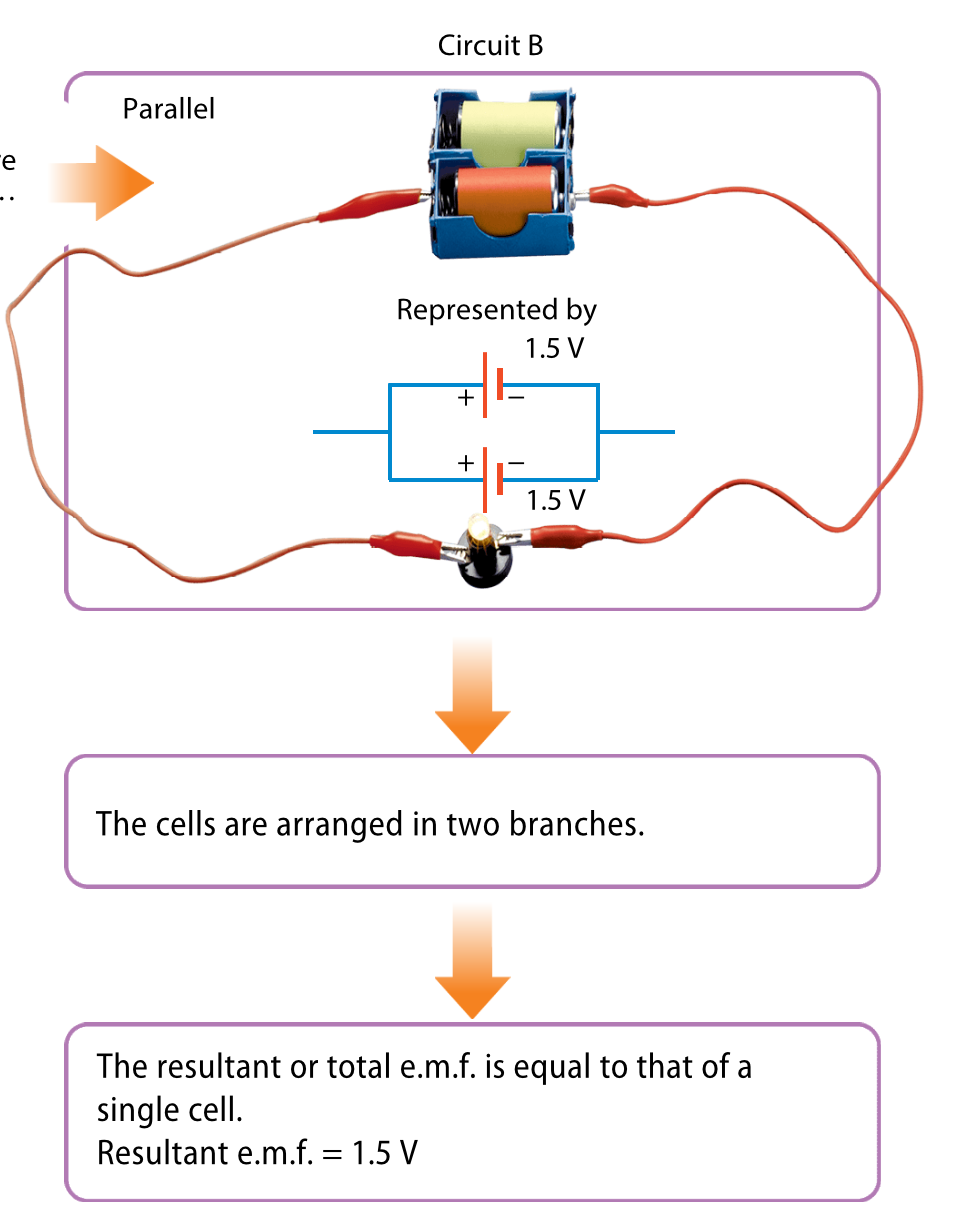 |
Energy is transferred → electrically → from chemical potential store of battery → to kinetic (rotation) and internal (thermal) store of motor.
- amount of electrical work done by each coulomb of charge → passing through motor → is called P.D.
Note
when cell is connected in opposite direction, i.e. same terminals facing each other, e.m.f cancels off, and is considered negative. subtract from final e.m.f value
Definition
Potential difference (p.d.) across a component in a circuit is the work done per unit charge in driving charges through the component
Formulae
we use V to represent p.d. SI unit of p.d. is volt (v).
V = potential difference or voltage across component (v) W = work done (j) Q = amount of charge (C)
as well
SI unit of p.d. or voltage = SI unit of e.m.f of an electrical source → even though potential difference is NOT electromotive force.
- we use term e.m.f for electrical source and term p.d. for component
Differences between e.m.f and p.d.
| Electromotive Force | Potential Difference |
|---|---|
| e.m.f → work done to move each unit charge through the circuit | p.d. → work done by each unit charge passing through the components |
| e.m.f is present even when no current is drawn from source | p.d. across any electrical component is zero in the absence of current |
Both e.m.f and p.d. → can be measured by voltmeter or digital multimeter
Note
to measure e.m.f or p.d. → voltmeter or digital multimeter → must be connected across or in parallel with electrical source or component. Positive terminal of electrical source → but be connected to positive terminal of voltmeter and vice versa
Important
common misconception about d.c. circuits → is that electrons are stored in battery → and supplied to circuit. NOT TRUE. electrons that flow through circuit → originate in WIRE of circuit. battery just supplies energy that moves the electrons
another misconception → is that energy is a quantity that can be “used up” NOT TRUE
- principle of conservation of energy Energy
- energy from chemical potential store of battery is transferred electrically to internal store of filament
Note
battery goes flat because → electrochemical reactions inside battery → have depleted the materials that produce these electrochemical reactions
Sample
Suggest why e.m.f of cell in circuit is slightly greater than p.d. across resistor
- work needed to drive charges through ammeter, and wires connecting circuit is not accounted for