Definition
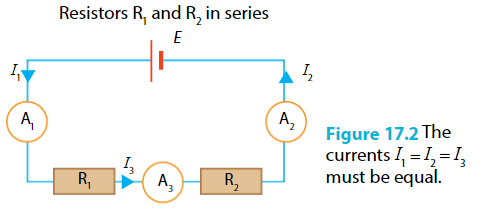
Series connection is one in which → components → are connected 1 after another in a single loop
Circuits with components in series arrangements = series circuits
Since there is only one single loop → electric current has only one path to flow through.
Important
In a series circuit, current at every point is the same
Potential Difference across a resistor is the work done per unit charge in driving the charges through that resister (Electromotive Force and Potential Difference)
→ thus there must be fall in electrical potential as the charge flows across and
→ these potential differences cannot be measured using voltmeter as shown.
→ the e.m.f of the cell E is equal to the sum of potential differences across and
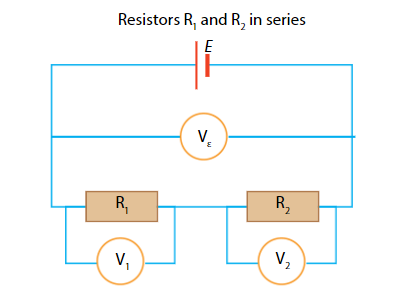
- voltage across source E = sum of and
Important
In a series circuit, the total potential difference supplied to the circuit E is equal to the sum of the individual potential differences across the resistors.
Mathematically in reference to above figure:
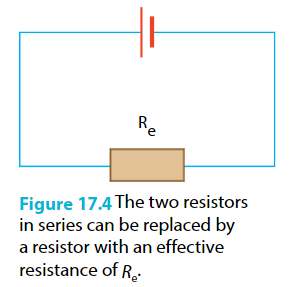
We can define effective resistance such that
hence circuit diagram in above figure can be replaced by equivalent circuit diagram below
Formulae
In General → if there are n resistors connected in series, then: Since PD = IR
This means that when resistors are connected in series → they can be represented by an effective resistance of
Important
In a series circuit, the effective resistance is equal to the sum of the individual resistances