Electrical resistance → slows down flow of electrons in a circuit.
- when electrons flow through component → they constantly collide → with ions of the components and other electrons
- these collisions oppose electron flow
- degree of opposing force → which electric current experiences → when it flows through component → is the resistance of component

Definition
Resistance R of a component is the ratio of the potential difference V across it to the current I flowing through it
Law
Ohms law: The current flowing through a component is proportional to voltage across it provided that physical conditions (such as temperature) remains the same.
Formulae
R = resistance of component () V = p.d. across component (V) I = current flowing through component (A)
For a fixed voltage → higher the resistance, smaller the current.
Resistance = scalar quantity SI unit = ohm ()
Resistors
Definition
A resistor is a conductor or an insulator that has resistance. It is used in a circuit to control the amount of current.
2 types of resistors: fixed and variable
Fixed resistor
- fixed value
- made of a mixture of finely powdered carbon and ceramic, held together by resin
- ratio of mixture → gives rise to different resistor values
- values marked with colour bands on resistor
- can have resistances that range from a few ohm to a several million ohms
Variable Resistors:
- can have diff. values of resistances
- e.g. rheostat and potentiometer
Basic construction of all variable resistors are same.
- diff. resistance values - set by moving slider along metal rod to change length of wire through which current flows through.
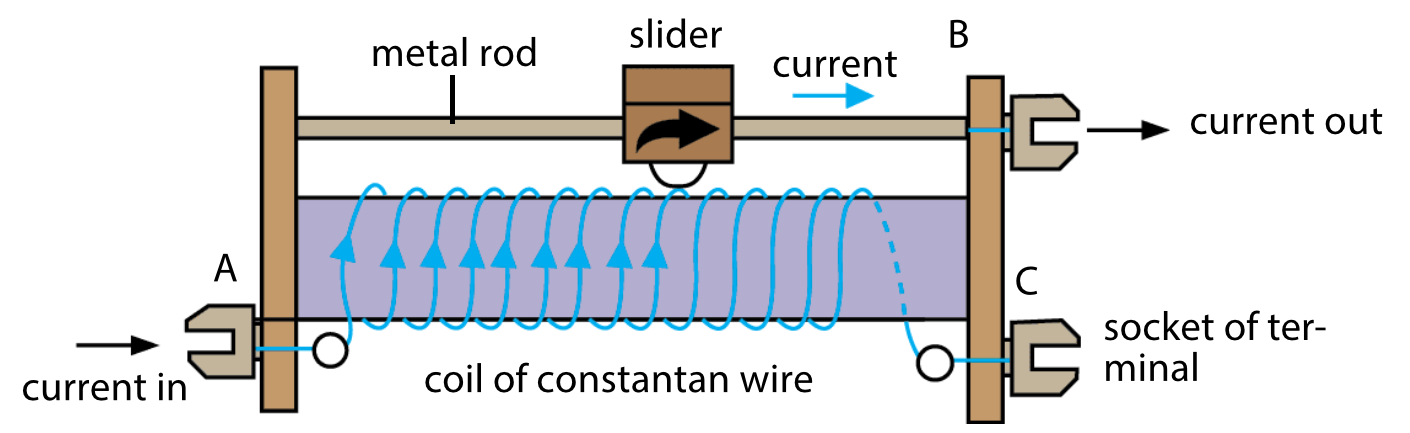
Resistance of Objects
- depends on its shape and material it is made of
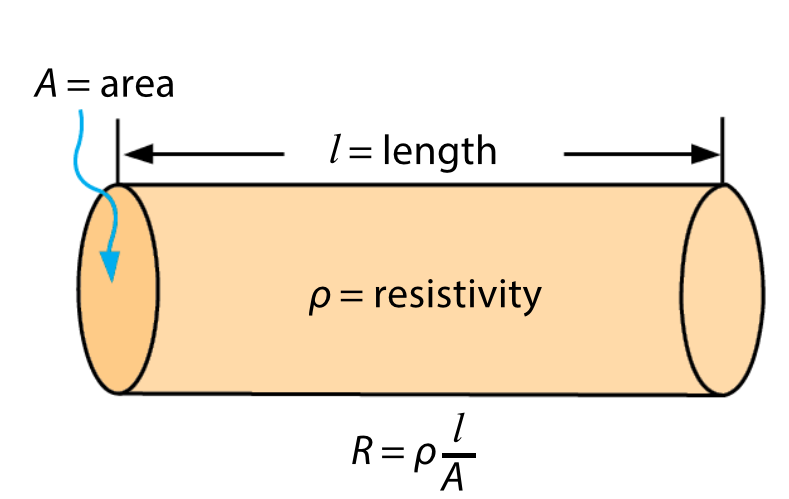
Consider Cylindrical Resistor
-
the longer the cylinder → the more collisions the electrons will make with its particles
-
hence resistance R of the cylindrical resistance is directly proportional to the length of the cylinder
-
the larger the cross sectional area A of the cylinder → the greater the number of electrons that can flow through it. (at once\per unit time or both)
-
thus resistance R of the cylindrical resistor is inversely proportional to the cross sectional area of the cylinder A.
Summary
Formulae
where k is a constant
we define a constant as the resistivity of a substance → that depends on what the material is composed of. Equation now becomes:
Formulae
Rearrange equation:
resistivity here is measured in
From → we can see resistivity is the resistance of a material for a unit area per unit length
- resistivity is independent of the shape or the size of the material.
- resistivity is an intrinsic property of a material
Common Resistivity of material measured at 20 degrees
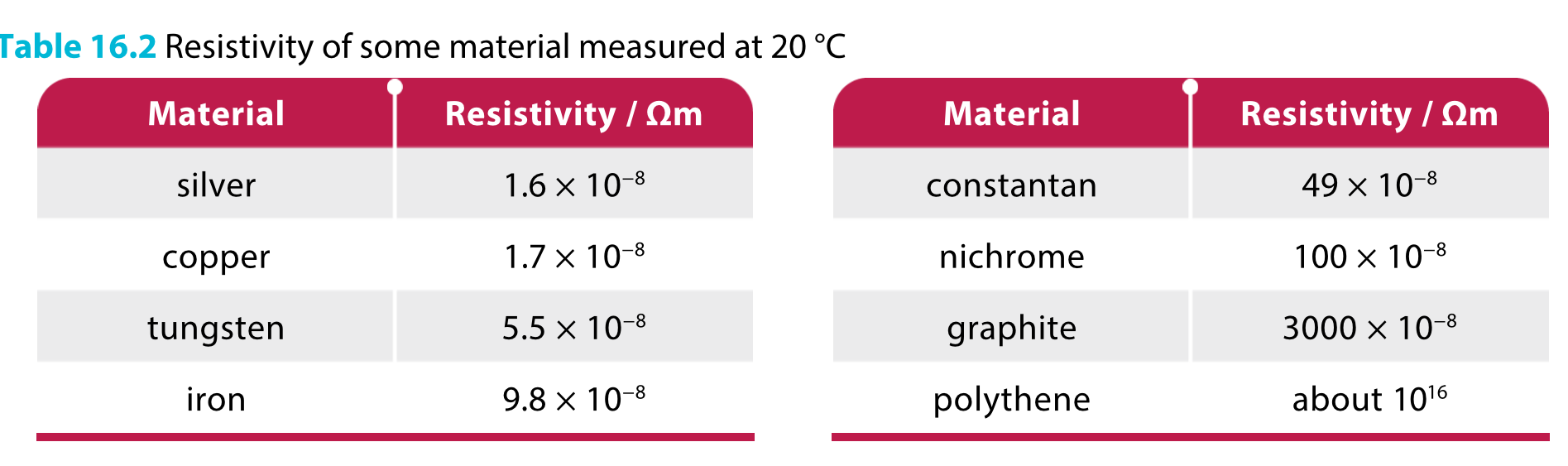
Materials with low resistivities → good COE
- copper is common metal that has low resistivity → often made into wires since electric current can flow easily through copper
Materials with high resistivities → poor COE.
- such materials generate lot of heat + can be used for heating purposes
Resistance With Regards to Temperature of Metals
Resistance with Regards to Temperature of Metals (Graph)
Summary
Resistance with regards to length of wire
- directly proportion relationship
- length of wire doubles, resistance also doubles
- assume cross sectional area remains same
Resistance of wire with regards to cross sectional area
- inverse proportion relationship
- if cross sectional area doubles, resistance halves
- assume length remain same