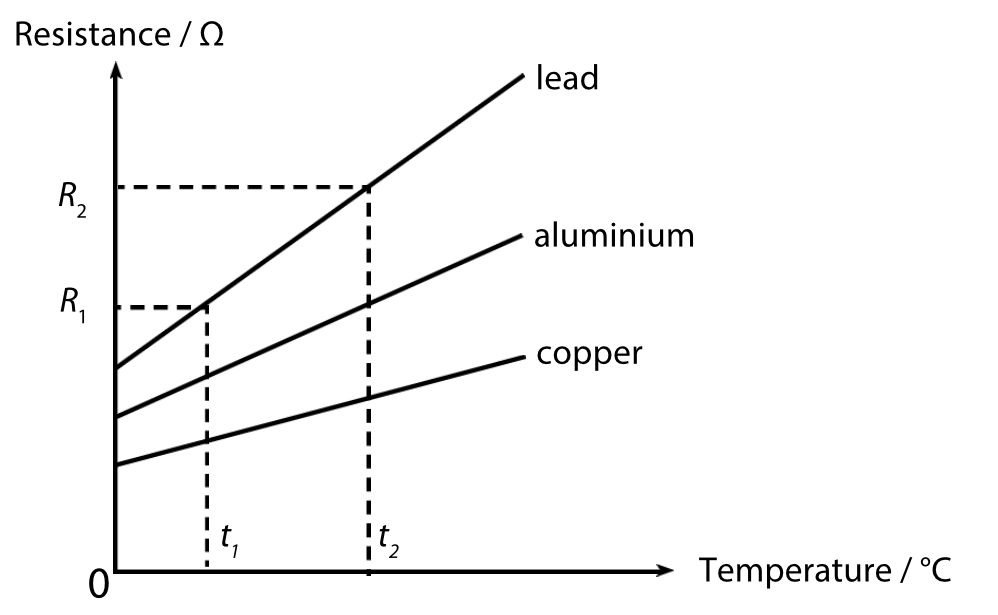
Resistance of most metals → increases → linearly with temperature
- resistance of lead → increases from to → when temperature increases from to .
→ at higher temperatures → metallic ions → vibrate more vigorously → about their fixed positions.
→ this increases number of collisions between free electrons and metallic ions → which in turn opposes or slows down flow of electrons
Resistance
- rearrange → form relationship between voltage and current →
- amount of current → directly proportional to potential difference V applied across material with resistance R.
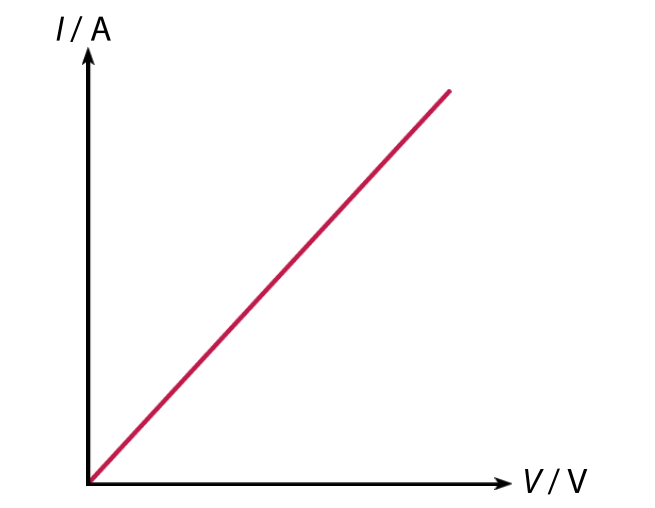
When material exhibits this linear relationship between p.d. V and current I → it is said to be ohmic
I-V characteristic graph → of ohmic conductor at constant temperature
Important
MUST pass through the origin!
Voltage across conductor → directly proportional → to current flowing through it.
- provided that all physical conditions and temperature remain constant
Conductors → do not have a direct proportional r.s. between V and I → known as non ohmic conductors
- this is because → resistances of these conductors → change → as temperature changes.
- Tungsten filament lamp → e.g. of non ohmic conductor
- resistance of tungsten increases as temperature increases.
- other examples of non ohmic conductors are diodes and negative temperature coefficient (NTC) thermistors
| Non Ohmic Conductor | I-V Graph | Description |
|---|---|---|
 | 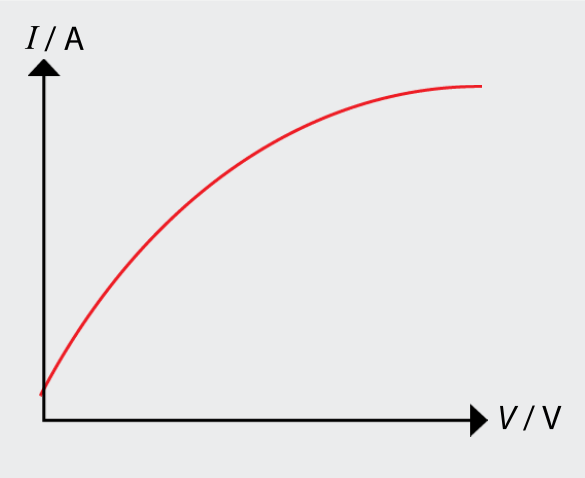 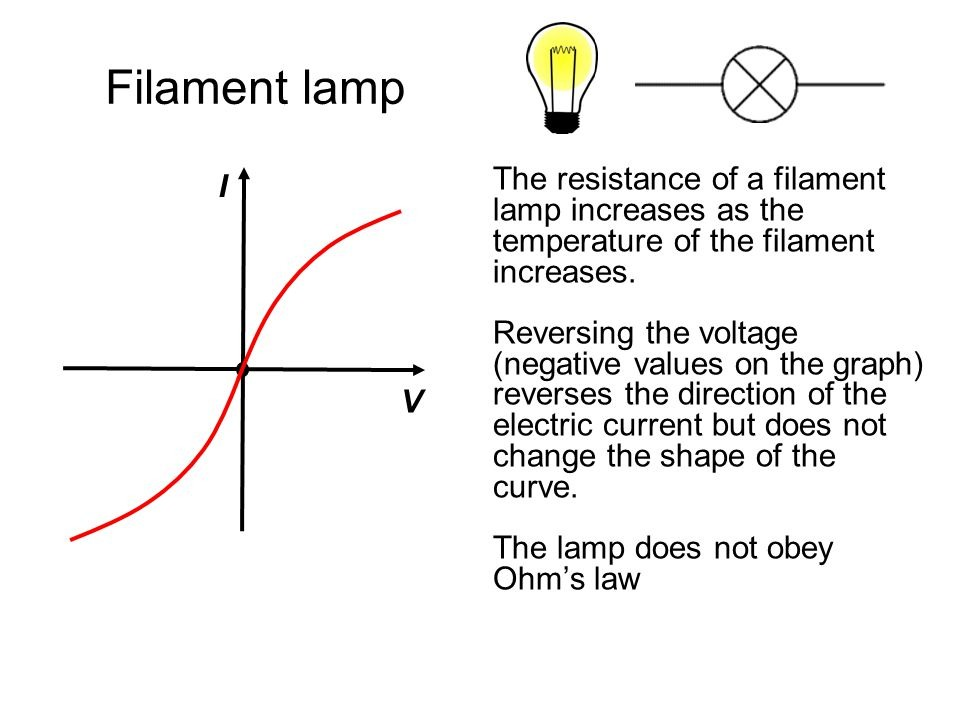 | As Electric current increases → more energy is transferred form CP store of battery to internal store of filament. → this in turn increases resistance of filament → which limits rate of increase of current. → ratio of V to I shows increase of filament resistance |
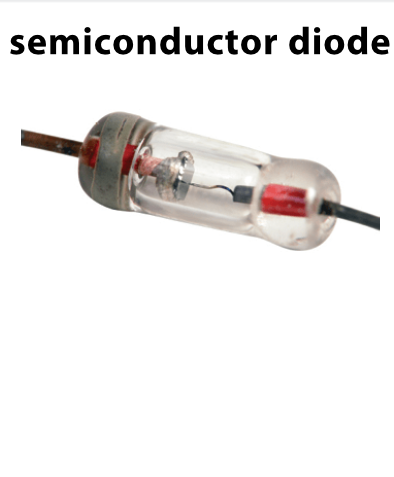 | 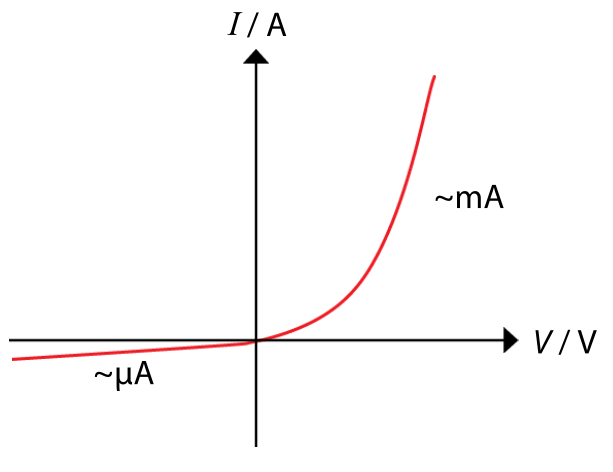 | When positive voltage is applied to the anode of a diode → large current flows. → resistance in forward direction is very low. In reverse direction → when positive voltage is applied to a cathode of a diode → current is very low or almost 0. → resistance in reverse direction → very high or almost infinite. very large resistance at start of graph, then decreases. |
Sample
HOW TO ANSWER? Describing I-V Graph similar toKinematics Main Note
- increase/decrease in current and voltage
- describe gradient. e.g. voltage increases with decreasing rate
- effect on resistance
- since graph represents equation V = IR.
- and gradient = resistance
Note
Function of semiconductor diode A semiconductor diode allows current to flow in only one direction, making it useful for rectification in circuits, where it converts AC to DC. It is also used for voltage regulation (e.g., Zener diode), signal demodulation, circuit protection (preventing reverse current), switching in digital circuits, and as a Light Emitting Diode (LED) for light emission.