Definition
A potential divider is a voltage divider, which make use of the voltage drop across resistors in series to divide voltage
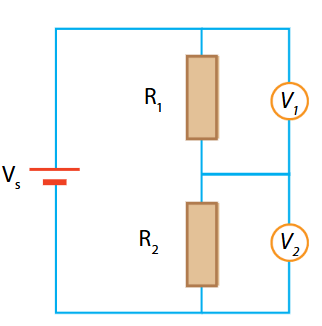
- current is same at every point in a series circuit.
- let this current be . Then P.D across resistors and would be given by and respectively.
Since sum of the p.d. in a series circuit is equal to the potential difference across the whole circuit.
Substitute (1) into (2)
The term is a proper fraction and has a value less than 1 Hence we can see that voltage is a fraction of the supply voltage
Likewise since:
Hence both and are fractions of the supply voltage and the fractions are determined by the choice of resistors and
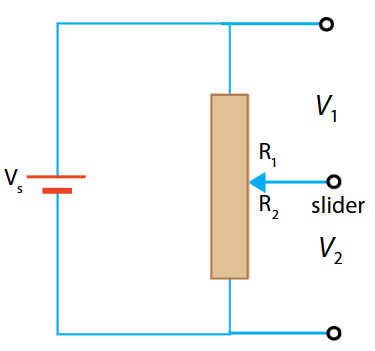 In the potential divider circuit → if we replace resistors and with a potentiometer → a continuous range of voltages for and can be obtained.
- larger values of can be obtained by increasing and vice versa
Example
example with circuit with potentiometer is found in the volume control knob of a radio or an electric guitar as shown in figure. circuit is also called variable potential divider.
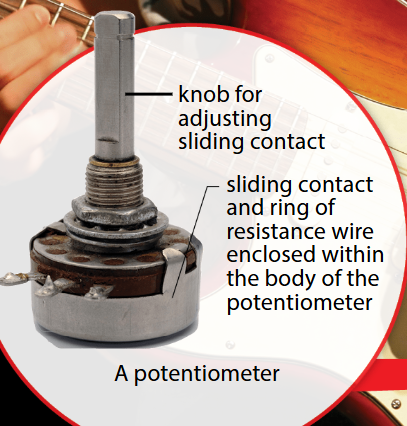
With potentiometer → potential differences and follow the same formula:
Ratio of resistances can also be expressed → in terms of length of the resistor or rheostat or the angle of turns of a potentiometer slider.
- since is proportional to , and may be expressed as: