Definition
Friction is the contact force that opposes or tends to oppose motion between surfaces in contact. #PhysicsDefinitions
⇒ result of irregularities of the surfaces.
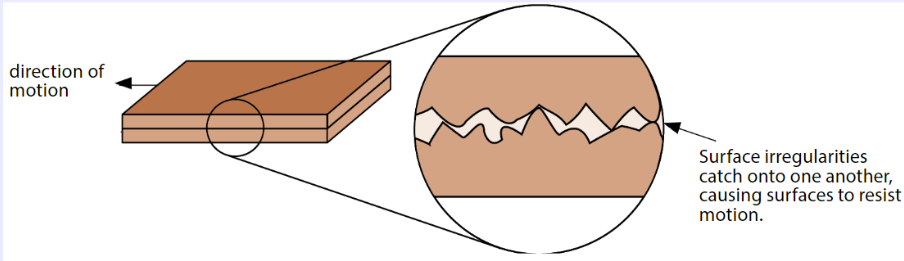 Eg; if force is applied to move a book across table towards the right ⇒ friction will act towards the left.
if applied force is removed ⇒ friction will cause the book to slow down and come to a stop eventually.
Eg; if force is applied to move a book across table towards the right ⇒ friction will act towards the left.
if applied force is removed ⇒ friction will cause the book to slow down and come to a stop eventually.
| Positive effects of friction | Negative effects of friction |
|---|---|
| We can walk without slipping | Cars are less efficient by up to 20% |
| Moving objects are able to slow down when needed | Moving parts in engines, motors and machine suffer wear and tear |
Reducing Negative Effects of Friction
| Using Wheels Being circular in shape, wheels greatly reduce the friction between objects and the floor. Smaller force can be applied to move the object around. | Using Ball Bearings Being spherical in shape - ball bearings are used to reduce friction between moving parts of machines, cars, and in line skates. Ball bearings - placed between moving parts so that ball bearings can roll around. Prevents the moving parts from rubbing against each other. |
| Using Lubricants and polished surfaces Applying a layer of lubricant, such as oil or grease - between surfaces in contact can greatly reduce friction Lubricants - frequently used between moving parts of an engine to reduce wear and tear. Helps to prolong the life of the engine. Polishing a surface removed surface irregularities. Can also reduce friction between surfaces in contact | Using air cushions Friction between two surfaces - reduced - when there is a thin layer of cushion between the 2 surfaces. |
Enhancing Positive Effects of Friction
| Using Threads | Using Parachute | Using Chalk |
|---|---|---|
| Friction - important to motion of vehicles. Without friction → vehicle cannot move as its tires will just spin at the same spot Friction - enables tires to grip the roads surface and roll without slipping Rainy day - moving vehicles may skid on wet roads. Tires need to have more grip on the road to prevent skidding. Thus, tires are designed with threads - grooves that quickly channel water out from underneath the tires. This improves grip of tires on wet roads, thus preventing skidding. | Air resistance (AR) → type of friction in the air. A skydiver in midair varies air resistance to change his speed. - To speed up → he reduces AR by reducing SA in contact with air (head first position) - To slow down → he increases AR by increasing SA in contact with air (spread-eagle position) - To achieve a safe landing - he increases AR significantly → making use of much larger SA of an open parachute. | Rock climbers - need to have firm grip on rock surface with their hands and feet. - Use chalk powder on their hands to absorb perspiration and improve their grip |