Effects of Forces on the motion of a body
- body at rest moves
- moving body increases speed
- Moving body decreases in speed
- moving body changes direction
When force applied on object ⇒ there is change in speed/ and or direction ⇒ there is a change in velocity Thus there is acceleration (or deceleration)
- thus, Force ⇒ can cause object to accelerate or decelerate
0 Acceleration ⇒ implies an object can be stationary or moving with constant velocity. ⇒ even though acceleration = 0, it does not mean there are no forces acting on it. it just means that the resultant of these forces is 0
Newtons Laws
Newtons First Law Newtons Second Law Newtons Third Law
Inertia
Some effects of Resistive Forces on Motion
Objects Falling without Air Resistance
Objects can only be in free fall if the only force acting on it is its own weight
Vacuum
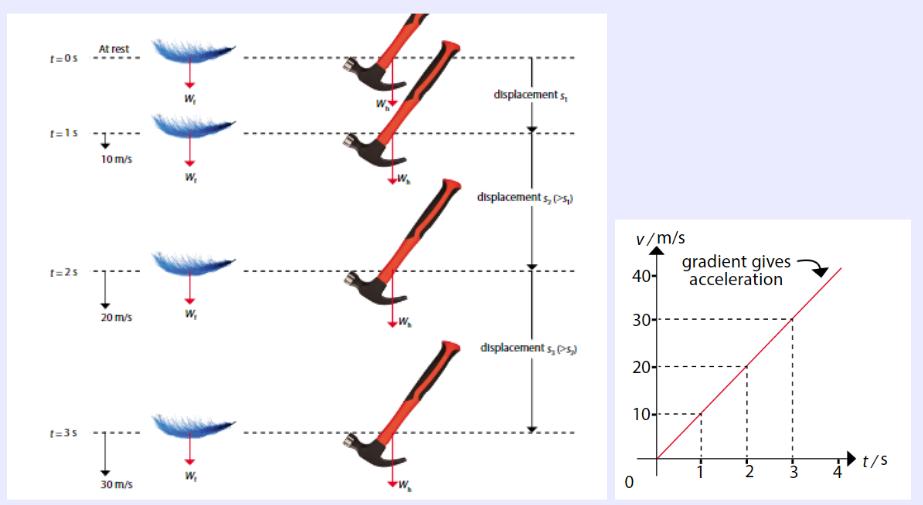
- Velocity of 2 objects under gravity increased by 10m/s every second (increases uniformly). both objects undergo constant acceleration of
- Direction of their motion is downward (towards center of earth)
- Acceleration of free falling objects ⇒ does not depend on their mass or size, all objects fall freely at a constant acceleration of (look at graph)
Objects Falling with Air Resistance
- always opposes the motion of moving objects
- increases with speed of the objects
- increases with surface area (or size) of the objects
- increases with density of the air
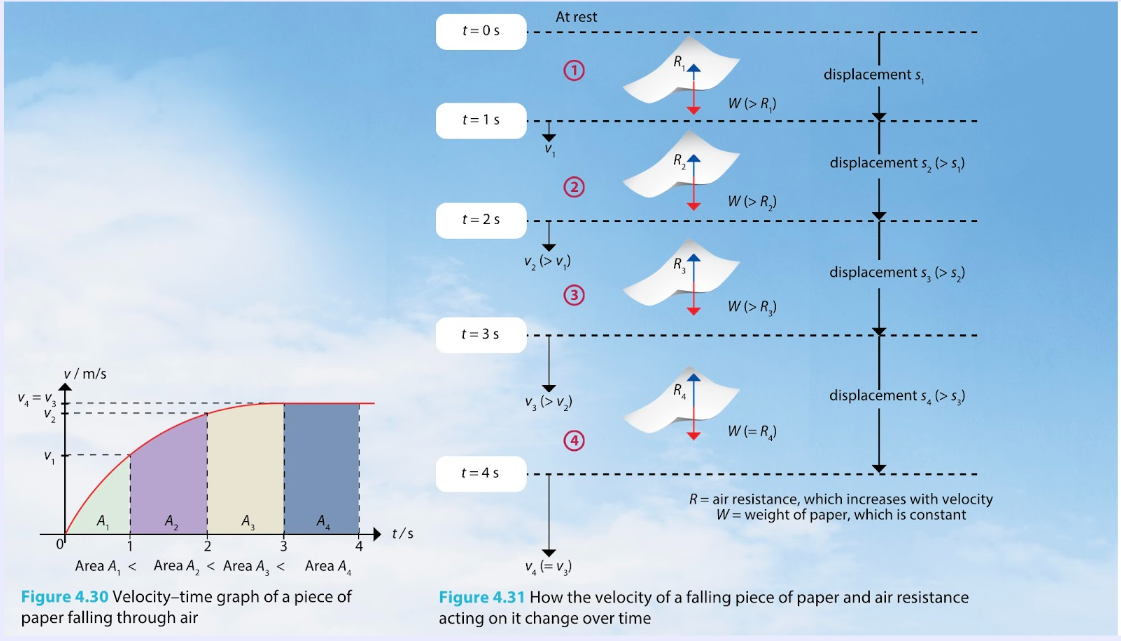
| Time Interval | Forces Involved | Changes in Velocity and Acceleration | Displacement |
|---|---|---|---|
| 1 | W > R | Velocity increases from zero to there is acceleration | = |
| 2 | W > | velocity increases from to smaller () < () acceleration is lower than in 1 | |
| 3 | Velocity increases from to smaller() < () Acceleration is lower than that in 2 | ||
| 4 | Velocity stays constant. = 0. i.ee = = terminal velocity. Acceleration is 0 | ||
| Small dense options (eg steel balls) ⇒ falls through air at the same acceleration and hit the ground at the same time. |
- this is because they experience lower air resistance
In comparison ⇒ piece of paper ⇒ is light and has larger surface area
- experiences greater air resistance. Paper falls at lower acceleration
Objects experience higher air resistance when speed increases.
Factors Affecting Air Resistance
- Speed
- Shape
- Density of air
When air resistance ⇒ acting against object ⇒ equals its weight, object starts to travel at a constant speed known as terminal velocity (PURE ONLY) → means object has 0 acceleration
If object travels through short distance ⇒ it may not reach terminal velocity before it hits the ground.
Skydiver A - spread eagle position (larger SA) Skydiver B - head first position (smaller SA) Skydiver A experience higher AR than skydiver B
Resultant force acting downwards on skydivers are their respective weights minus the respective air resistances acting upward on them. Since weights of both skydivers are the same → resultant force acting downwards on skydiver A will be smaller than that acting on skydiver B. Smaller resultant force means smaller acceleration for the same mass, thus smaller rate of increase in velocity. Hence, skydiver A is above skydiver B.
Answering Techniques
- Describe the motion when resultant force is acting on it in the opposite direction to the motion
- Object slows down in the direction of motion.
- Always state in which direction the force acts and between the 2 bodies.
- Explanation for increasing air resistance with increasing speed:
- The increase in air resistance will reduce the net force acting on the object. Thus, the acceleration of the object will decrease
- Always state the effect on the net force of the object. ALWAYS
- Always describe every factor from the equation;
- Example: for F= Ma, explain every factor (force, mass, acceleration) when using this formula
Important
normal contact force acts between every single point in contact
Important
driving force on a car is always on the wheel
Sample
the component of weight along the slope causes xxx to roll down
when the ball is falling down, there is some velocity for a split second upon contact with floor as the ball is compressing and shifts a little bit.
it is important to take into consideration that inertia is not a property of a body
- mass it the property that causes object to be reluctant to motion.
- cause effect relationship* mass > inertia