Definition
Newtons third law of motion states that if body A exerts a on body B, then body B will exert an equal and opposite force on body A. #PhysicsDefinitions
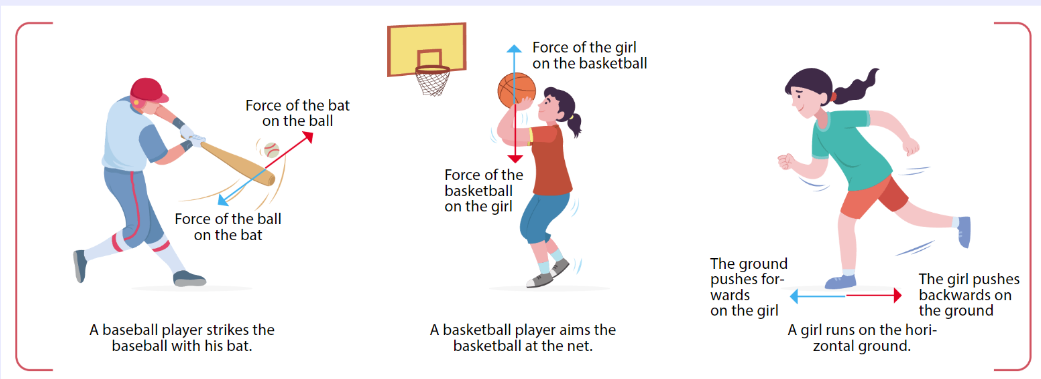
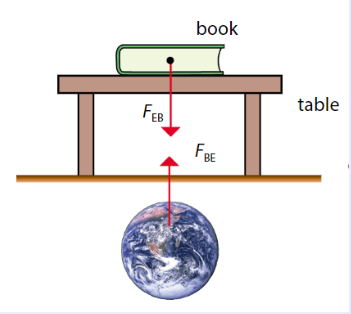 | 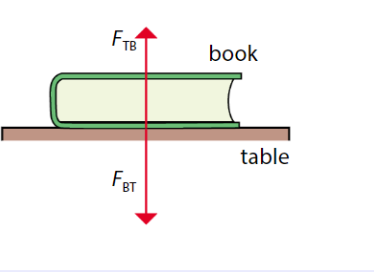 |
| → gravitational force of earth on book → gravitational force of book on earth | → normal force by table on the book → normal force by the book on the table |
Pair of action reaction forces are shown
- gravitational force → exerted by earth on book → and the upward force exerted by book on earth
- Normal force → by table on the book → and the normal force by the book on the table
Each action and reaction pair are equal ⇒ in magnitude but act in opposite directions.
Hence ⇒ force of the table on the book ⇒ does not form an action reaction pair with the weight of the book.
Newtons third law of motion tells us 4 characteristics of force
- forces always occur in pairs ⇒ each pair is made up of an action and a reaction force
- action and reaction forces are equal in magnitude
- action and reaction forces act in opposite directions
- action and reaction forces act on different bodies
How are 2 forces in an action reaction pair identical
- both forces are of same type
- magnitudes of both forces are equal How are 2 forces in an action reaction pair different
- Act in opposite directions
- Act on 2 different bodies