Waves are used to transfer energy from one point to another without transferring the matter* r___ Waves → often used to explain physical phenomena ⇒ such as light and sound.
Basic Family of waves → sinusoidal waves.
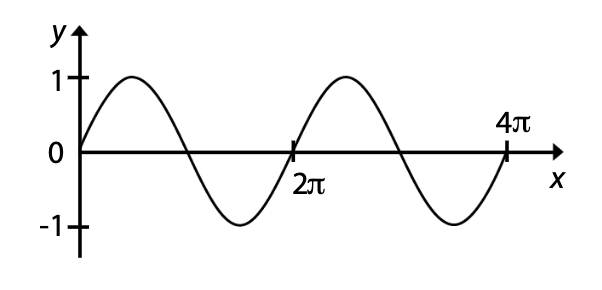
By adding simple sinusoidal waves ⇒ complex waves can be constructed.
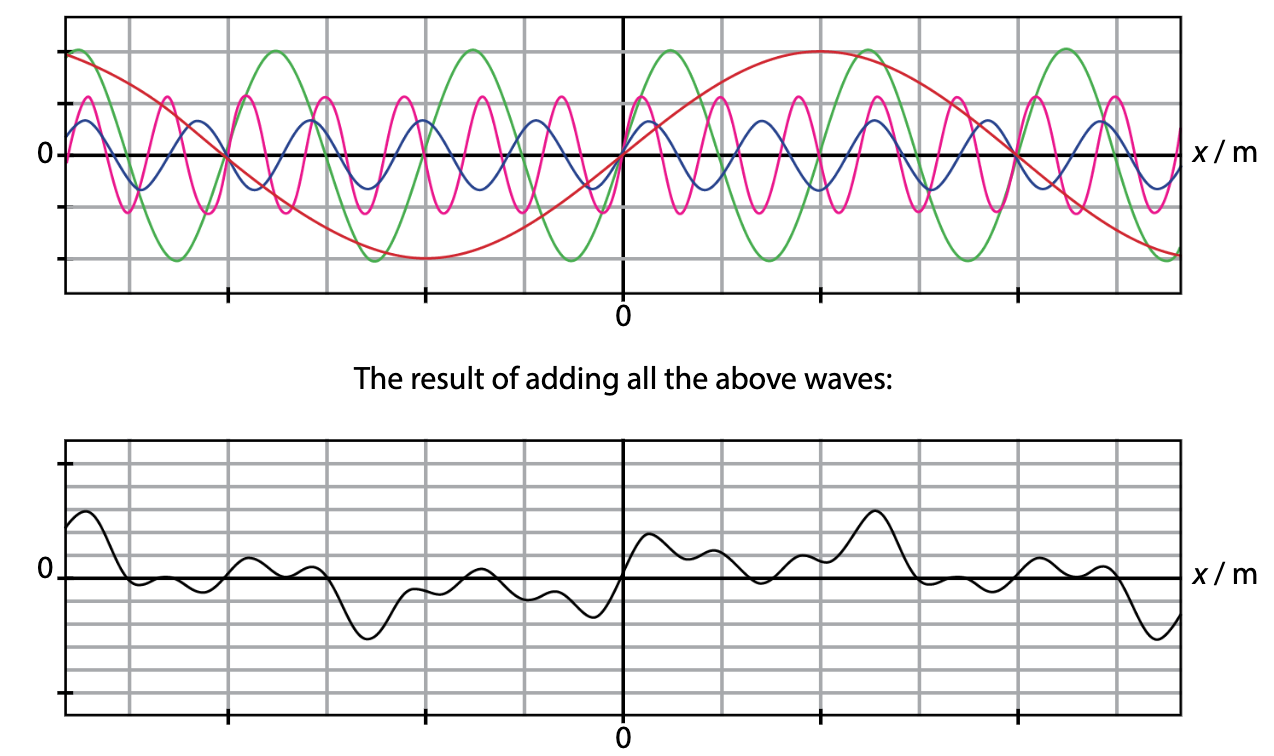 Example in which simple waves are added to generate a complex wave occurs in a synthesizer.
synthesizer ⇒ sound waves ⇒ are added in chosen proportions to create a new sound.
Sinusoidal wave can also be combined to cancel each other out, such like in NCH
Example in which simple waves are added to generate a complex wave occurs in a synthesizer.
synthesizer ⇒ sound waves ⇒ are added in chosen proportions to create a new sound.
Sinusoidal wave can also be combined to cancel each other out, such like in NCH
Example of Waves
Water Waves
Waves ⇒ can be produced in water using ripple tank and a wave generator. → water waves or water ripples are not equally spaced. for systemic studies, regular waves are needed. ⇒ regular waves are produced by a wave generator electrically powered device has a dipper driven by a motor.
Waves on a Rope
Waves can also be created using a rope.
one end is fixed to wall and other end is moved repeatedly and regularly in a direction that is perpendicular to the rope
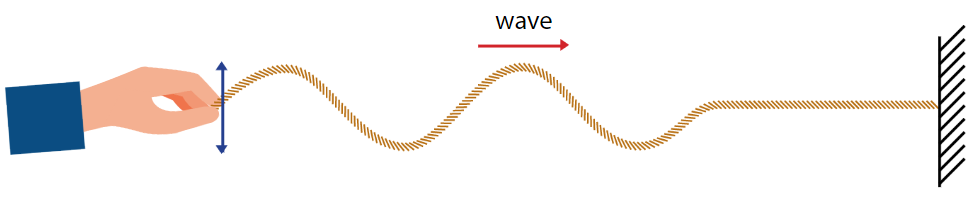 Direction in which wave shape (or wave profile) moves is the direction of the wave.
⇒ waves direction here is towards the fixed end (moves towards the right).
within each wave ⇒ particles motion is perpendicular to the waves direction.
hence, rope is the medium through which the wave moves.
Direction in which wave shape (or wave profile) moves is the direction of the wave.
⇒ waves direction here is towards the fixed end (moves towards the right).
within each wave ⇒ particles motion is perpendicular to the waves direction.
hence, rope is the medium through which the wave moves.
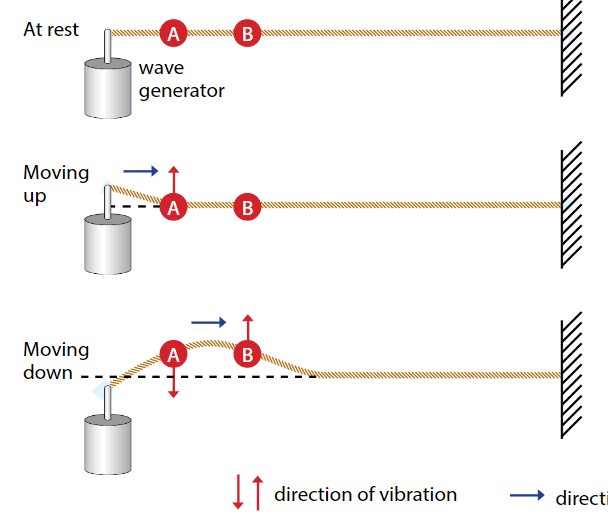
- wave generator is used to create regular waves
- when the wave generator is turned on, left side of the rope moves upwards. segment A is pulled up, and this in turn pulls segment B up
- ups and down motion at A is passed along the rope. motion that is being transferred from 1 segment to its adjacent segment tells us that kinetic energy is transferred along the rope.
Segments A. B and all subsequent segments do not move along the rope. there is no transfer of matter along the rope. For any segment n the rope ⇒ motion is described as cyclical or periodic because after moving up or down, it returns to original position.
Definition
A wave is a disturbance that propagates through space, transferring energy with it but not matter #PhysicsDefinitions
Waves on a Spring
Spring with a fixed end can be stretched on the floor.
Besides moving the free end up and down like the wave on the rope ⇒ we can push and pull the free end of the spring rapidly ⇒ to create the waves.
waves travel along the spring and move towards the fixed end.
⇒ direction moved by the waves is parallel to the direction of the hand motion.
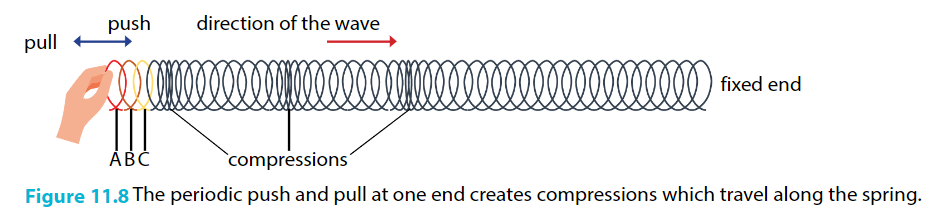 ⇒ focus on single segment of spring
example its A ⇒ it is in a cyclical or periodic motion.
motion is transferred to the adjacent segments B, then C and towards the fixed end.
⇒ focus on single segment of spring
example its A ⇒ it is in a cyclical or periodic motion.
motion is transferred to the adjacent segments B, then C and towards the fixed end.
while the waves in the rope and the spring do not have same appearance ⇒ there are similarities between the waves.
Water Waves in a Ripple Tank
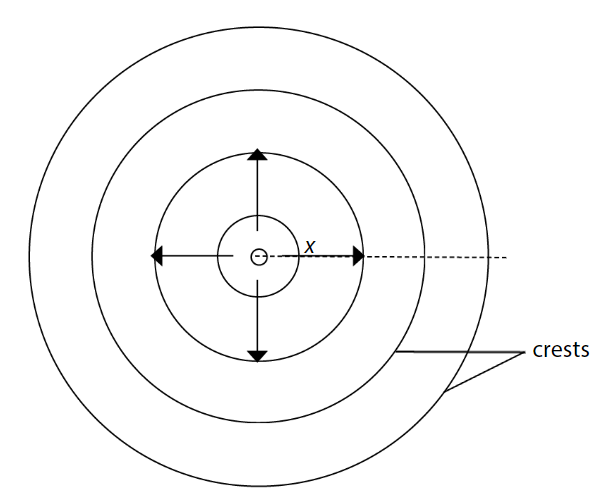
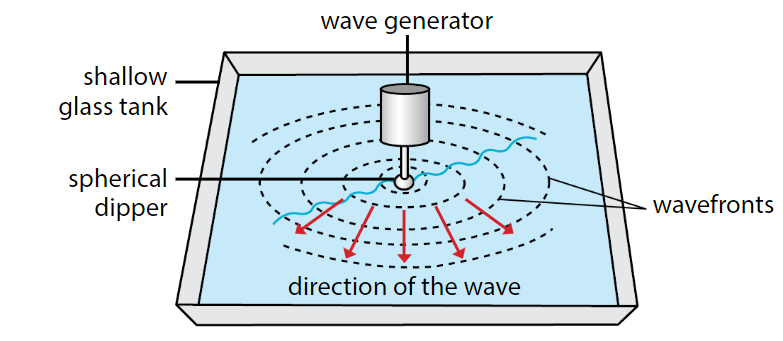
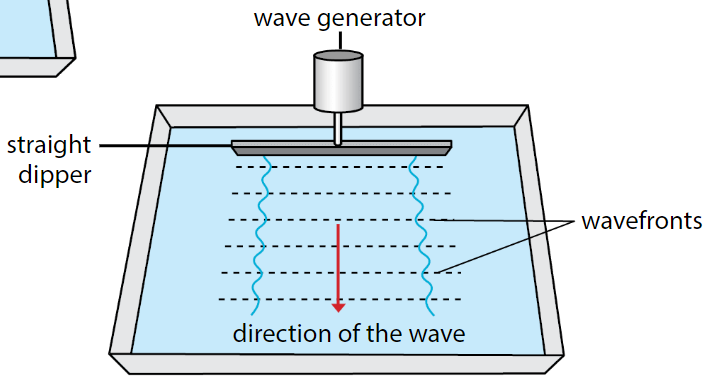
Ripple tanks is set up to demonstrate basic properties of water waves. ⇒ shallow glass tank of water is placed below a wave generator connected to a dipper when dipper touches the water surface ⇒ circular waves are produced. imaginary line that joins all adjacent points on the wave are in phase ⇒ such as the crests ⇒ is called a Wavefront
 |  |
|---|---|
| wave generator is mounted with its vibrating rod touching the water surface. When the dipper moves up and down, a series of circular ripples are generated (circular waves) | Long flat strip is mounted to the wave generator. When the dipper moves up and down ⇒ series of straight ripples are generated. (plane waves) |
| From examples of waves on a rope, spring and ripple tank ⇒ we can observe that motion of any selected point in a wave is periodic and repetitive. | |
| this motion is known as vibration or *Oscillation |
How can we Describe Characteristics of Waves
How can we Describe Characteristics of Waves
Wavefronts
speed of waves can also be deduced by observing Wavefronts
Wavefront ⇒ is an imaginary line joining all adjacent points that are in phase.
from the ripples produced in the ripple tank ⇒ crests and troughs can be identified.
each continuous circle of a crest or trough forms a Wavefront.
by considering particular point x on a crest and measuring how fast it travels away from the source ⇒ we can find the speed of the wave.