Types of Wave Motion
waves can be described as transverse and longitudinal.
Definition
Transverse wave has direction of vibration that is perpendicular to the direction of wave travel #PhysicsDefinitions
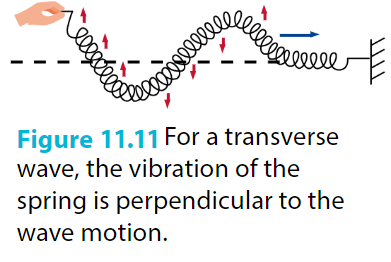
Definition
Longitudinal wave has a direction of vibration that is parallel to the direction of wave travel #PhysicsDefinitions
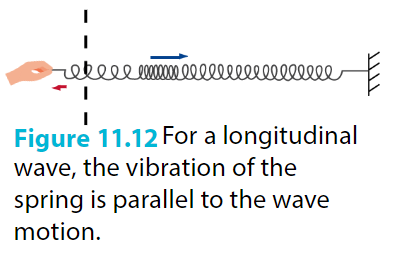
Examples of transverse waves: light waves, vibrating guitar string when plucked
Examples of longitudinal waves: sound waves, certain waves of an earthquake
Basic Characteristics of Waves

- Displacement: of any point on the wave is a vector pointing from its rest position to the point (Point P has displacement represented by the arrow)
- In Phase describes 2 points on a wave that always have same direction of motion (moving in step).
- For example: P and P’ are in phase. All crests on a wave are always in phase. All troughs on a wave are always in phase
- Amplitude: of a wave is its maximum magnitude of displacement from its rest position.
- Crests: are the highest points of a transverse wave
- Wavelength is the shortest distance between 2 successive crests or troughs
- Troughs: are the lowest points of a transverse wave
Dotted line ⇒ indicates ropes resting position before wave was created shape of the wave is called the Waveform
2 points along the wave are said to be in phase if they are at the same stage in a cycle. ⇒ implies that they always have the same direction of motion
As wave travels from left to right ⇒ we observe that points 1 and 3 will alw3ays be in the same phase.
points 1 and 3 are said to be moving in phase:
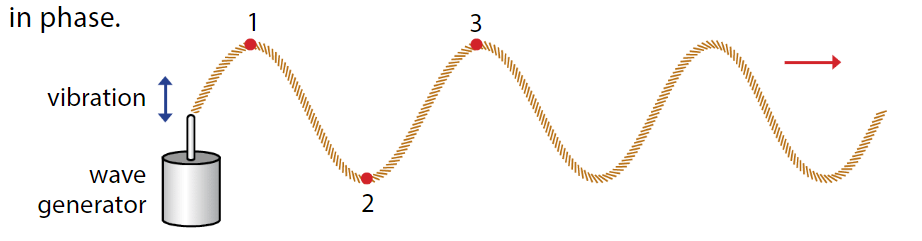 Points 2 and 3, while taking same time to complete each cycle ⇒ are always in opposite directions or completely out of step.
points 2 and 3 are said to be completely out of phase.
Points 2 and 3, while taking same time to complete each cycle ⇒ are always in opposite directions or completely out of step.
points 2 and 3 are said to be completely out of phase.
Graphs
Displacement-Distance Graph Displacement-Time Graph
Relationship Between Period, Wave Speed, Frequency and Wavelength
Relationship Between Period, Wave Speed, Frequency and Wavelength