-
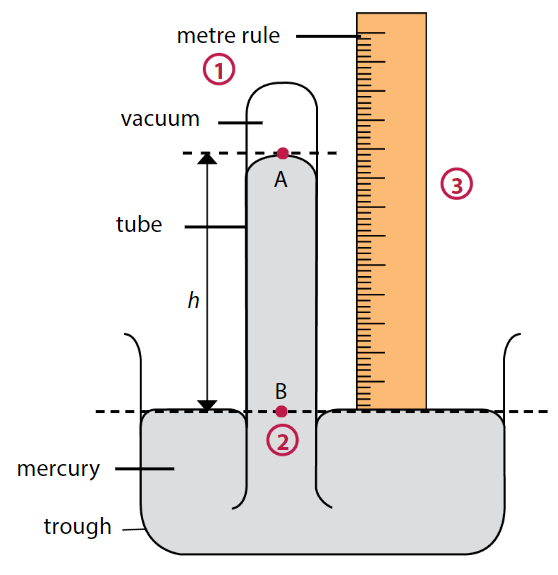
1m long thick walled glass tube is filled completely with mercury ⇒ tube is inverted into a trough containing mercury. Some mercury flows out from the tube in the trough while most of the mercury remains in the tube. Space above point A is a vacuum. Thus pressure at A () is 0
-
Mercury in tube ⇒ supported by atmospheric pressure exerted on surface of mercury in the trough. Thus pressure at B ⇒ which is level with surface of mercury in the trough ⇒ is the same as the atmospheric pressure. To determine pressure at B:
-
Height of the mercury column h can be measured with a meter rule. Height h is found to be 760mm. Taking density of mercury is 13600 and gravitational field strength as , pressure at B is: = 103kPa
Note: vertical height of mercury column ⇒ depends only on atmospheric pressure.
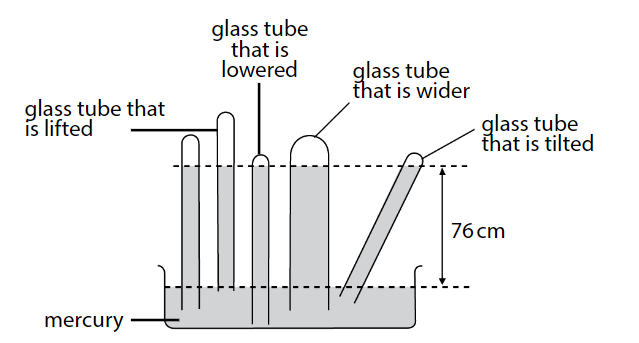
does not depend on size of tube used nor how deep tube is placed into trough of mercury.
→ even if tube is lifted, lowered or tilted, vertical height ⇒ of mercury column ⇒ remains same.
Thus, mercury barometer is a reliable instrument to measure atmospheric pressure.
Atmospheric pressure ⇒ often expressed in terms of mm Hg or cm Hg (Hg is the chemical symbol for mercury) One atmospheric pressure ⇒ often written as 760mm Hg or 76cm Hg
When there is crack in tube ⇒ there is atmospheric pressure acting in the space above liquids in the tube. This atmospheric pressure is equivalent to the external atmospheric pressure acting on the reservoir of liquid Since there is no pressure difference, there is no difference between liquid level in the reservoir and the liquid level in the tube as the magnitude of pressure acting on both liquid levels are identical.