Definition
Pressure is the force acting per unit area #PhysicsDefinitions
Formula P - pressure (Pa) F - force (N) A - contact area ()
SI unit: , also known as Pascal (Pa)
1kPA - Pa 1MPa - Pa 1atm = 101.325kPa = 101,325Pa 1stp = = 0.1MPa = 100kPa
Factors affecting pressure:
- Greater the magnitude of force, greater the pressure
- Smaller the contact area, larger the pressure
Pressure ⇒ scalar quantity ⇒ because only force perpendicular to the contact area is considered when calculating pressure.
- since direction of force remains unchanged ⇒ pressure depends only on magnitude and is independent of direction
Transmission of Pressure through an Enclosed Liquid (Pure Only)
Pascals Principle or Pascals law
Pascals principle or Pascals Law: Definition: if pressure applied to an enclosed liquid, pressure is transmitted to all other parts of the liquid undiminished.
- this is multiplier effect of hydraulic press.
How is Height of a Column of Liquid used to Measure Pressure
Density
Definition
density is defined as mass per unit volume PhysicsDefinitions
#physicsFormulae = density M = Mass (kg) V = volume ()
SI unit: Kg per cubic meter Water ⇒ 1000kg/ Mercury ⇒ 13600 Kg/
Determining Density of Liquid
- weigh empty graduated measuring cylinder
- pour liquid into measuring cylinder and weigh both measuring cylinder and liquid
- determine mass of liquid by subtracting reading in step 1 from reading in step 2
- volume of liquid can be measured using measuring cylinder
- density of liquid can be calculated using formula
Determining Density of Solids Need to measure mass and volume as well ⇒ mass can be found using electronic balance volume of irregular solid ⇒ can be found by immersing solid in water and measuring volume of water displaced
volume of regular solids ⇒ such as cuboid or cylinder ⇒ can be calculated using measurements made by measuring instruments and applying appropriate geometric formula
Density ⇒ used to identify substances or purity of substance
Measuring pressure ( only for pure)
Pressure in liquid ⇒ increases with depth pressure ⇒ we feel underwater ⇒ comes from weight of water above us
- as we dive deeper ⇒ there is more water above us. Weight of water above us is greater so we feel an increase in water pressure
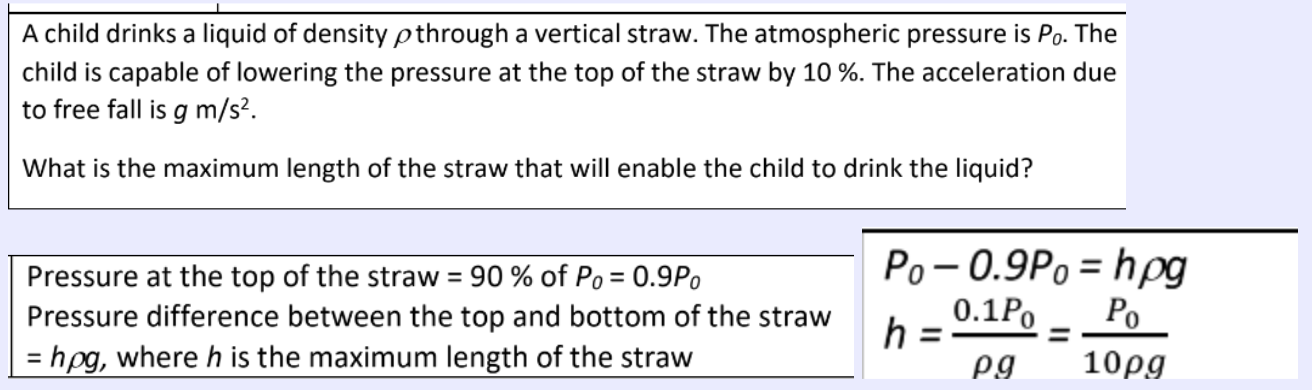
When top level is air-liquid interface ⇒ pressure of liquid at surface is taken as 0. If you have an atmospheric pressure acting as well ⇒ total pressure at given depth below liquid surface =
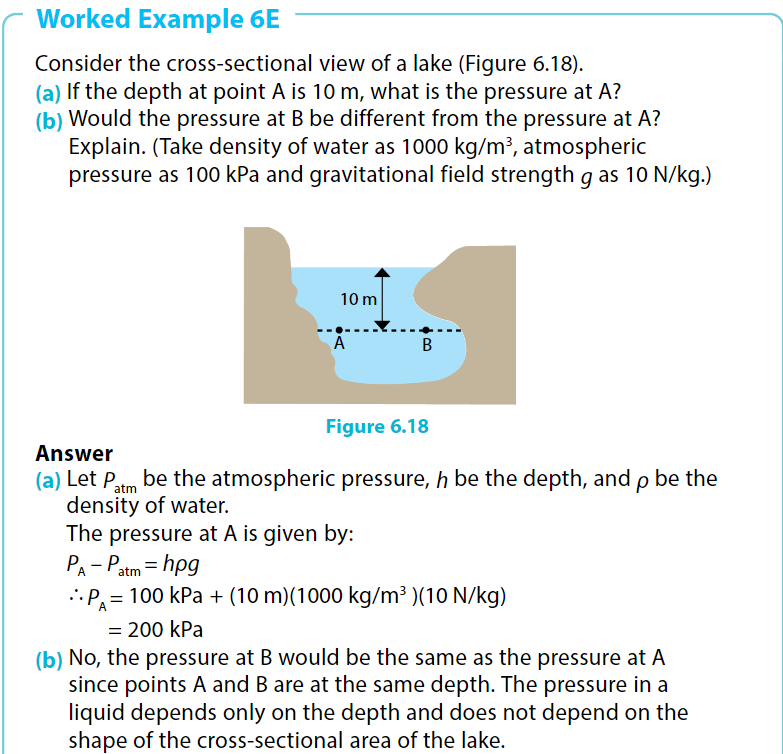
Pressure between 2 levels in a liquid is given by h = height (m) = density (Kg/) g = gravitational field strength (N/Kg)
pressure at given depth ⇒ beneath liquid surface ⇒ depends only on change in depth, as density and gravitational field strength do not change.
Shape of container does not come into picture at all
Volume and cross sectional area of liquid ⇒ do not affect pressure at any point in a liquid
Mercury Barometer
Manometer
Answering Techniques for Pressure
- whenever you’re talking about pressure difference ⇒ talk about how there is a net pressure/Force and in what direction
- Always state where pressure acting comes from, and the direction in which it acts. (Example: pressure acting on mercury surface by the oil column)
Example Questions (Hard)