-
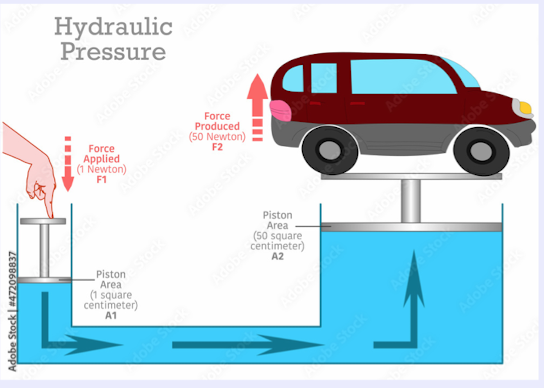
Force is applied on piston 1 Pressure exerted on piston 1 and hence the liquid is where is the area of piston 1. This is equation 1
-
As liquid cannot be compressed, pressure would be transmitted equally(undiminished) to other parts of the liquid and to piston 2
-
pressure exerted on piston 2 is , where is the force on piston 2 and is the area of piston 2. this is equation 2. Substitute equation 1 into 2: = =
since is much larger than , force is much larger than
Final Formula
is a multiple of . Multiple is given by the ratio of areas of to Thus, hydraulic press has a multiplier effect (proportional increase Converts relatively small force () on a small piston into a relatively large force on a large piston
Example Question Explain why hydraulic press would not work if liquid contains bubbles of air
- bubbles of air are compressed when piston is pushed. Leads to a shorter distance moved by other piston as the pressure on piston X would not be equally transmitted to all parts of the liquid. Force applied would be used to compress bubbles of air as well. thus, lesser pressure is applied on the piston, which leads to a smaller force applied on larger piston. This means hydraulic system will not work Efficiently
Related topic: Pascals principle or Pascals Law:
Definition
if pressure applied to an enclosed liquid, pressure is transmitted to all other parts of the liquid undiminished.
- this is multiplier effect of hydraulic press. #PhysicsDefinitions Pascals Principle or Pascals law