Internal Energy:
Definition
Internal energy is an energy store that is made up of the total kinetic energy associated with the random motion of the particles and the total potential energy between the particles in the system. #PhysicsDefinitions
Heat Capacity and Specific Heat Capacity
Different bodies/objects → have different capacities to store internal energy
- Number of particles
- When there are more particles, more energy can be stored
- Thus larger objects have larger heat capacities
- Nature and strength of intermolecular forces
- Stronger force between particles allow more energy to be stored for the same extension of compression.
- Thus for the same volume, solids and liquids tend to have larger heat capacities than gasses.
| Heat Capacity |
|---|
| Definition: Heat Capacity C is an object is the change in the amount of its internal energy per unit change in its temperature. |
physicsFormulae |
| Where Q = amount of energy transferred (J) to or from the internal store to the object by heating. Delta theta = change in temperature (K or C) |
| SI unit of heat capacity is joule per kelvin (J/k) or joule per degree Celsius (J/C) |
| Specific Heat Capacity |
|---|
| specific heat capacity c of a material is the change in amount of its internal energy per unit mass for each unit change in temperature. |
physicsFormulae |
| where C = heat capacity (J/k or J/C) Q = amount of energy transferred (J) to or from internal store of the material by heating m = mass of substance (Kg) delta theta: Change in temperature (K or C) |
| SI unit of specific heat capacity - joule per kilogram per kelvin (J/(Kg K)) or joule per kilogram per degree Celsius (J/ (Kg C)) |
| another common unit: Joule per gram per kelvin (J /(g K)) |
| Heat capacity → is seen as property of an object that can consist of parts made of different materials. |
| on the other hand - specific heat capacity → is seen as the property of uniform material. |
Calculations involving heat capacity and specific heat capacity
| → we can rewrite the formula for heat capacity and specific heat capacity Thus, energy Q transferred by heating to an object of heat capacity C so that object has a temperature change (delta theta) is: physicsFormulae |
| For substance made of uniform material of mass m, specific heat capacity c and a temperature change delta theta, the energy Q transferred by heating is: physicsFormulae |
| Objects with lower specific heat capacity will show a larger increase in temperature compared to that with a higher specific heat capacity when the same amount of energy is supplied. |
| Another useful formula for this chapter is the power formula. |
| P = E/t, P= WD/t |
| can be found in Energy |
Processes that involve a change of state
At its boiling point → temperature of water cannot increase further. → this is because the rate at which energy is transferred away with the steam equals the rate at which energy is supplied to the water. → water does not always boil at 100 degree Celsius!!
ATM is lower at higher altitudes → which results in a lower boiling point of water. Increased pressure above hot water surface → will make it more difficult for steam to form and escape. This will raise the boiling point of water. Thus food in a pressure cooker is cooked faster.
Changes of State:
Boiling and Evaporation Both boiling and evaporation → involves vaporization (change from liquid to gas) During boiling → bubbles are seen throughout liquid Boiling point → remains constant assuming there is no change in atmospheric pressure.
Evaporation of liquid → only takes place at the surface of the liquid exposed to air.
- Particles in liquid move at different speeds.
- Evaporation occurs when the faster particles at the surface of the liquid have enough energy to break away from the other liquid particles to escapeinto the air. → note that this is assuming that particles do not collide with the fast moving air particles and move back into the liquid.
- After faster particles have escaped into the air - particles left behind have slightly lower average kinetic energy.
- As temperature decreases with average kinetic energy of particles in a body ⇒ liquid is slightly cooler than surroundings. → this temperature difference leads to transfer of energy from surroundings to liquid.
| Boiling | Evaporation |
|---|---|
| needs heat source | does not need heat source |
| vaporization takes place throughout the liquid | Vaporization takes place only at the liquid surface. |
| Rate of evaporation is faster | rate of evaporation is slower |
| Happens only at the boiling point | Happens at temperatures below the boiling point |
| Liquid temperature remains constat | Liquid temperatures tends to drop. |
| Pressure → when pressure is higher → rate of evaporation is lower. → at higher pressure → liquid molecules escape into the air less quickly | Temperature → when temperature is higher →rate of evaporation is higher. at higher temperature → average kinetic energy of liquid molecules is higher. More liquid particles can escape into the air. | Humidity of air. → Humidity → Measure of amount of WV in the air. → when humidity is high →there is a lot of WV in air and rate of evaporation is lower. |
| Wind (moving air) →removes the molecules that have just escaped into the air. Thus → air surrounding liquid is drier. Hence when wind speed is higher → rate of evaporation is higher.** | Surface area of liquid When exposed SA of liquid is higher → rate of evaporation is higher. This is because more molecules can escape from the surface of the liquid.** | Boiling point of the liquid Liquid with lower boiling point → evaporates more quickly than one with higher boiling point under similar conditions. This is because attractive forces between particles of the liquid with a lower boiling point are weaker. |
Latent Heat
Definition
Latent Heat is the energy released or absorbed to change the state of a substance, at a constant temperature. #PhysicsDefinitions
2 types of latent heat:
- For melting and solidification: latent heat of fusion
- Boiling and Condensation: latent heat of vaporization Unit of latent heat - j
Latent heat of Fusion
When the substance is melting → energy is transferred to the substance through work done against attractive forces between the particles. → there is an increase in potential energy of the particles but the kinetic energy of the particles remains unchanged. When solidifying → energy is transferred out of the substance which leads to decrease in potential energy of particles but kinetic energy of particles remains unchanged. Hence there is no temperature change when a substance is melting or solidifying.
| Definition: Latent Heat of Fusion, Lf is the amount of energy transferred to change a substance between solid and liquid states, at constant temperature. PhysicsDefinitions |
| Specific Latent Heat of Fusion |
| Mass of substance → affects latent heat of fusion. |
| Definition: Specific latent heat of fusion l_f is the amount of energy transferred per unit mass of a substance to change between solid and liquid states at a constant temperature. PhysicsDefinitions |
physicsFormulae |
| = latent heat of fusion (J) = specific latent heat of fusion (J/Kg) m = mass of substance (Kg) |
| To find specific latent heat, formula can be rewritten as: physicsFormulae |
Latent Heat of Vaporization
when substance is boiling → energy is transferred to substance through work done against attractive forces between particles. there is an increase in potential energy of particles but kinetic energy of particles remain unchanged.
| Definition: Latent heat of Vaporization is the amount of energy transferred to change a substance between liquid and gaseous states, at a constant temperature. PhysicsDefinitions |
| Specific Latent Heat of Vaporization |
| Definition: Specific latent heat of vaporization l_v is the amount of energy transferred per unit mass of a substance to change it between liquid and gaseous states, at a constant temperature. |
physicsFormulae |
| where = Latent heat of vaporization (J) = specific latent heat of vaporization (J/Kg) m = mass of substance (Kg) |
| To find specific latent heat of vaporization, formula can be rewritten as: physicsFormulae |
Heating and Cooling
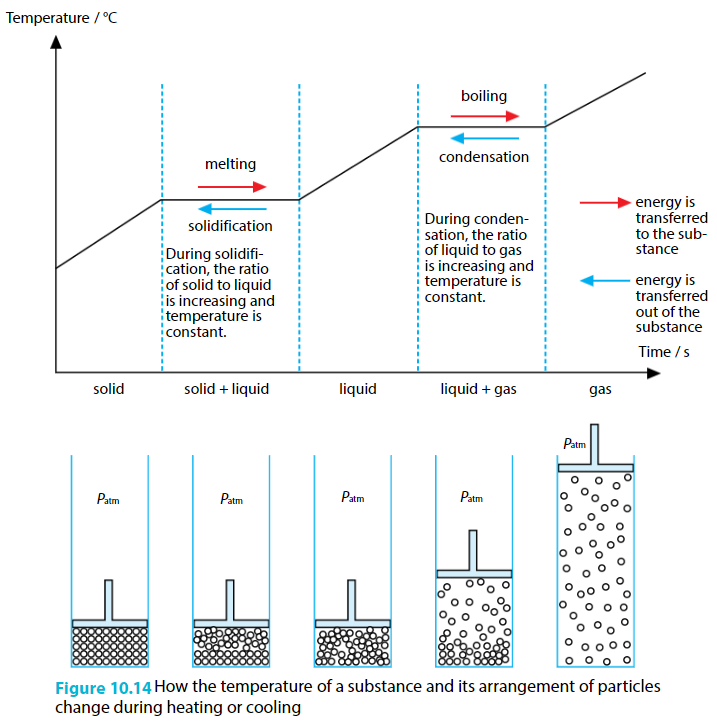
Heating Curve
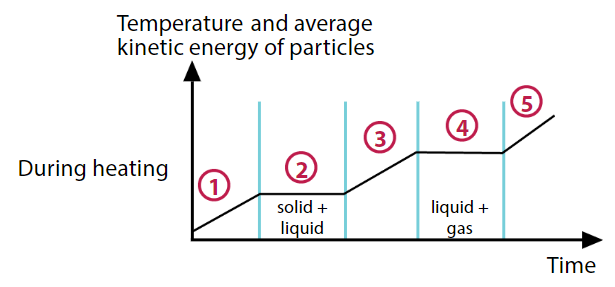 1, 3, 5
- during heating, energy transferred to substance allows particles to move faster and there is an increase in kinetic energy (store?).
- Temperature increases with average kinetic energy, so the temperature increases.
- Potential energy(store?) of particles increases with the increase in average separation of the particles.
2 and 4
- During melting and boiling, energy transferred to a substance results in work done against attractive intermolecular forces. Average separation of particles increases, and so the potential energy increases.
- However, Kinetic energy and temperature remain constant. (energy transferred to the substance is used to do this work)
Cooling Curve
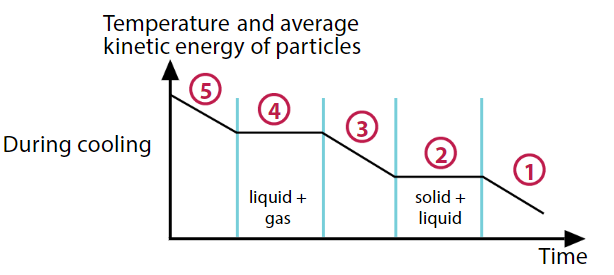 5, 3 and 1
- During cooling, energy is transferred out of the substance and the particles move slower. there is a decrease in their kinetic energy.
- Temperature of substance decreases.
- Potential energy of the particles decreases as the average separation of particles decreases.
4 and 2
- during condensation and solidification, energy is transferred out of the substance. Average separation of particles decreases and so the potential energy decreases.
- However, Kinetic energy and temperature remain constant. (energy transferred out of this substance is… ?)
Internal energy = total kinetic energy of particles (increases with temperature) + total potential energy of particles (increases with distance between particles.)
Internal energy - increases when it is heated Internal energy - decreases when it is cooled
Important Points
What do gradients of heating and cooling curve tell you
Heating curve:
-
solid phase: gradient represents specific heat capacity of the solid phase
-
liquid phase: gradient represents specific heat capacity of liquid phase
-
Gas Phase: gradient represents specific heat capacity of gas phase
the larger the gradient → the smaller the specific heat capacity
Cooling Curve: same as heating curve; SHC
Explain Why temperature remains constant during a change of state: Energy Absorbed/ transferred is used to overcome intermolecular forces of attraction (work done against intermolecular forces of attraction) for a change of state from solid to liquid as a substance undergoes melting. Internal potential energy increases as average separation of particles increases while internal kinetic energy remains constant. Hence there is no change in temperature. Must state: NO ENERGY IS TRANSFERRED TO INTERNAL KINETIC STORE.
if cooling → energy transferred to surrounding as bonds are formed ++
just remember to state how potential increases/decreases and then the kinetic remains constant. since temperature is correlated to average kinetic energy of particles ⇒ it remains constant. ++ thermal energy is used to overcome intermolecular forces of attraction (work done against intermolecular forces of attraction)
Explain Why latent heat of vaporization is greater than latent heat of fusion:
- higher latent energy is required so that the vapor can overcome atmospheric pressure and escape into the air. (there is no need to overcome atmospheric pressure when it just from solid to liquid, but it has to overcome this from liquid to gas)
- more energy is required to do work against intermolecular forces of attraction between liquid and gas compared to between solid and liquid.