Skin forms a protective covering over the body surface. ⇒ also plays role in the regulation of body temperature and excretion.
Vertical Section of skin
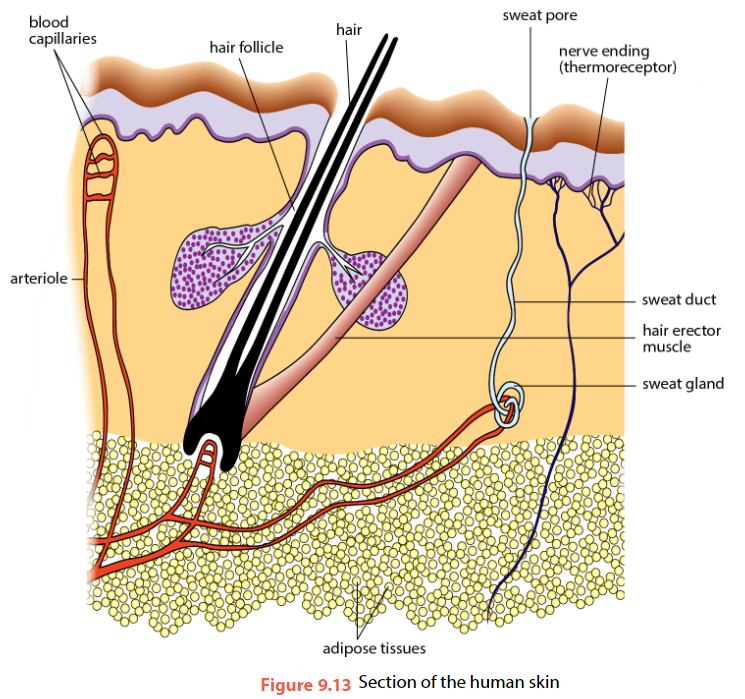
Blood Vessels (Capillaries and Arterioles) Under Skin Surface
Blood Vessels are present under skin surface. Constriction and dilation of arterioles ⇒ caused by contraction and relaxation of muscles in the arteriole walls. ⇒ contraction and dilation of arterioles help to regulate body temperature.
Dilation of arterioles ⇒ called vasodilation → when skin arterioles dilate ⇒ more blood is sent to blood capillaries in the skin. ⇒ this is shown when we blushed or become flushed aver vigorous activities. ⇒ skin turns red → because numerous blood vessels in the skin dilate
Constriction of the arterioles in the skin > or Vasoconstriction → reduces amount of blood flowing through capillaries in the skin and causes us to become pale.
Sample
- more/less blood flows through blood capillaries in the skin per unit time
- more/less heat is taken to the surface.
- more/less heat lost from the skin via conduction, convection radiation
Sweat Glands
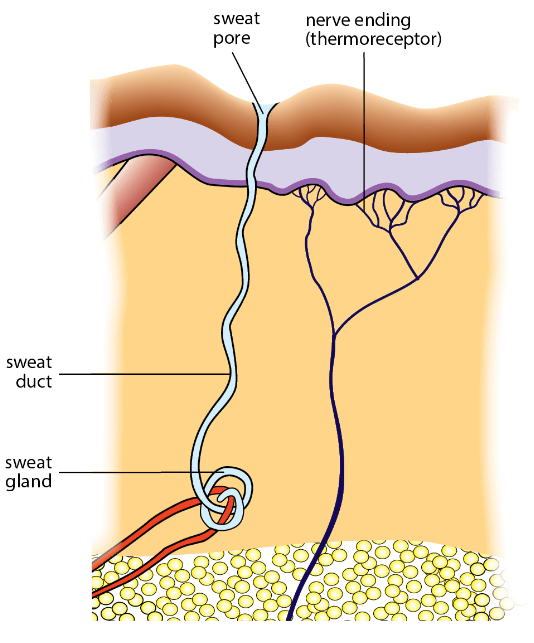
Secreted sweat flows through a sweat duct to a sweat pore that opens at skin surface. ⇒ secreted sweat → is mainly made up of water that it contains dissolved salts (mainly sodium chloride) + small amount of urea. Since sweat contains small amounts of metabolic waste products → such as urea → skin is considered an excretory organ.
Sweat is secreted continuously. ⇒ amount of sweat produced varies on external and internal env conditions.
Sweat ⇒ is a means by which skin regulates body temperature
Sample
explain how increased sweating helps to lower body temp
- more water in sweat → evaporates from surface of the skin
- more LATENT HEAT OF VAPOURISATION is lost from the body Thermal Properties of Matter (Pure Only)
Sensory Receptors (Thermoreceptors)
Sensory receptors ⇒ are structures in the body that detect changes in the environment (i.e. stimuli) ⇒ nerve endings in the skin are sensory receptors. ⇒ enable you to feel a sense of pain, pressure and temperature changes in ext. environment.
Receptors that detect temperature change: Thermoreceptors
How is Body Temperature Regulated
Important
the hair ereector muscles are not related to shivering in any way