Note
Gamete → sex cells produced by reproductive organs. e.g. sperm and eggs
Modes of Reproduction
Asexual Reproduction
Sexual Reproduction
Comparison
| Asexual Reproduction | Sexual Reproduction |
|---|---|
| Does not involve fusion of gametes | Involves fusion of a male gamete with a female gamete to form a zygote |
| Requires only 1 parent | Requires 2 parents (except for plants with bisexual flowers) |
| Offspring are genetically identical to parent | Offspring are genetically dissimilar to the parent |
| Relatively quicker method of producing offspring | Slower method of producing offspring |
Processes
What is Mitosis
What is Meiosis
Haploid Vs Diploid Cell
Consider male and female gamete
- Each contains 1 set of 3 chromosomes.
- During fertilisation, nucleus of male gamete fuses with nucleus of female gamete
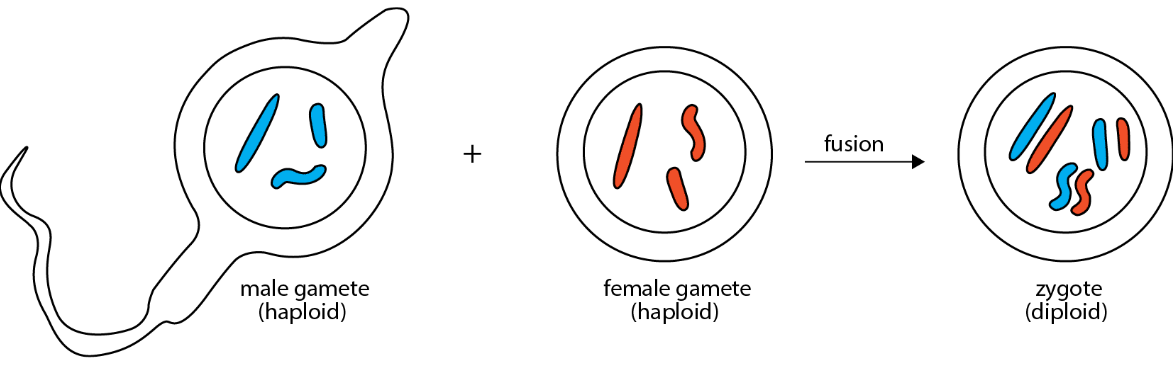
Fertilised female gamete / zygote produced → will have 2 sets of chromosomes.
- Hence zygote has 3 sets of chromosomes.
Haploid Cell (e.g. gamete) is a cell with 1 set of chromosomes Diploid Cell (e.g. zygote) is a cell with 2 sets of chromosomes. one set from the male parent and other from female parent.
Summary
Mitosis vs Meiosis
| Mitosis | Meiosis |
|---|---|
| Parent cell has 23 pairs of homologous chromosomes | Parent cell has 23 pairs of homologous chromosomes |
| Parent cell undergoes DNA replication first | Parent cell undergoes DNA replication first |
| 2 daughter cells obtained | 4 daughter cells obtained |
| Each daughter cell has 23 pairs of homologous chromosomes. It is diploid | Each daughter cell has 23 chromosomes. It is haploid |
| Daughter cells are genetically identical to each other and to the parent cell | Daughter cells are genetically dissimilar to one another and to the parent cell. |