Definition
Ion is a charged particle formed from an atom by gain or loss of electrons #ChemistryDefinitions
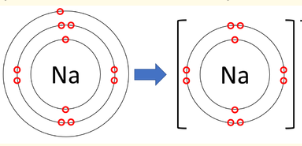
Positive Ions
- Atom loses electrons
- No longer an atom - as atoms are electrically neutral
- Positively charged as it has more protons than electrons
- Metal atoms - tend to lose electrons - form cations.
(positive ions - have net positive charge + noble gas electronic configuration)
 Negative Ions
 - Gain 1 or more electrons
- Negatively charged - more electrons than protons
- Most nonmetals - gain electrons - form anions.
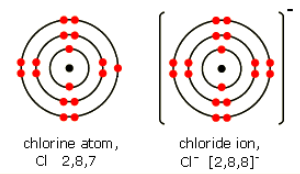
Anions: End with the suffix ‘ide’ Not all atoms form ions - atoms of noble gas. They already have stable octet, stable duplet configuration. Fully filled valence shells. Thus, noble gasses are monatomic - already stable.
The Ionic Bond
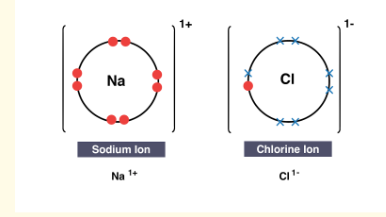
Definition: The Ionic bond is the strong electrostatic forces of attraction between positive ions (cations) and negative ions (anions) → there are mutual electrostatic forces of attraction between ions of opposite charges → makes them move towards each other and remain in position.
- electrostatic attraction → very strong at close range → holds ions together
- there is an ionic bond between the 2 elements
Ionic Compounds
Definition
Ionic Compounds are pure and neutral substances which are made up of cations and anions held together by strong electrostatic forces of attraction (ionic bonds) #ChemistryDefinitions
Most ionic compounds are SOLIDS
ionic compounds → form between metals and non metals → have no net charge → total positive charge from cation = total negative charge from anion
| How are Ionic Compounds and Ionic Bonds Formed (description to hone understanding) | How are Ionic Compounds and Ionic Bonds formed (answering technique) |
|---|---|
| - When metal reacts with non metal - electrons are transferred from atom of metal to atom of non metal - Metal atom loses electrons to the non metal to form a cation - Non metal atom gains electron from metal ion to form anion - Ions of opposite charges are attracted to each other due to electrostatic forces of attraction | Describing the process in words: - Magnesium has electronic configuration of 2.8.2 and chlorine has electronic configuration of 2.8.7 - In the reaction, each magnesium atom loses 2 valence electrons to 2 chlorine atoms and becomes Mg 2+ ion, which has a stable octet electronic configuration of 2.8. It is positively charged - Each chlorine atom, gains an electron from the Mg atom to become Cl-(chloride) ion which has stable octet electronic configuration of 2.8.8 - Ions of opposite charges are attracted to each other due to strong electrostatic forces of attraction. - The Mg2+ and Cl- ions in MgCl → held together by strong electrostatic forces of attraction (strong ionic bonds) - Move towards each other and remain in position Explaining Using Diagram 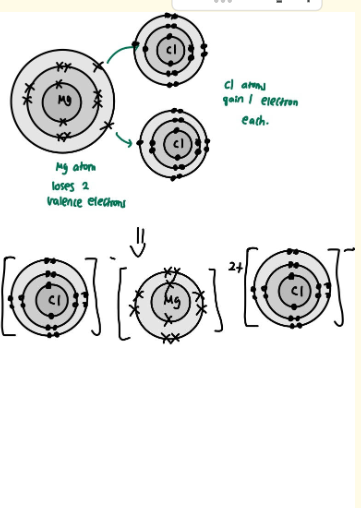 Mg+ and Cl- ions in MgCl - held together by strong electrostatic forces of attraction (strong ionic bonds) |
Ionic Structures
Positive and negative ions - exert electrostatic forces all around themselves.
- Means that positive ion that is already attached to a negative ion - will still electrostatically attract other negative ions
- Similarly, negative ions will attract positively charged ions
In solid state - ionic compounds - exist as a 3 dimensional giant lattice structure
- Structure consists of an uncountably large number of sets of sodium and chloride ions (eg) → all regularly spaced and held together by ionic bonds (strong mutual forces of attraction)
Definition
Giant ionic crystal lattice structure is a 3D structure alternating positive and negative ions. #ChemistryDefinitions
Characteristics
- orderly arranged
- vibrate about fixed positions
- very closely packed together, in a fixed ratio
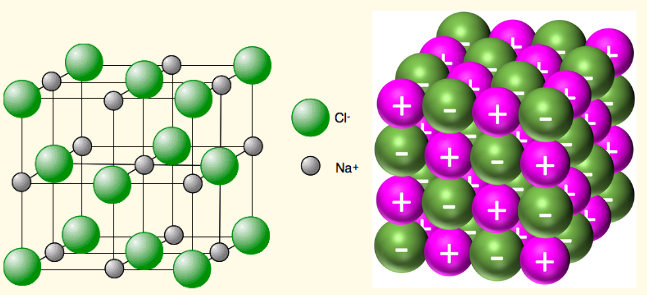 Ions of opposite charges → held in regular and repeating pattern.
→ lines in diagram → indicate closest attraction between positive and negative ions
Ions of opposite charges → held in regular and repeating pattern.
→ lines in diagram → indicate closest attraction between positive and negative ions