Structural Properties
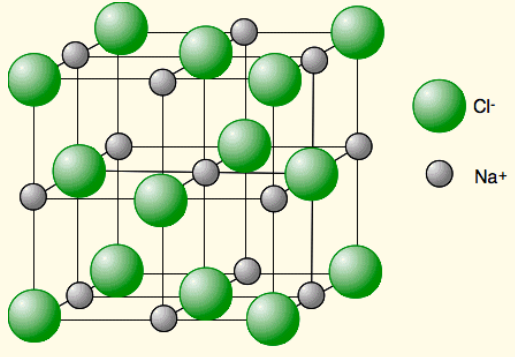
- Ionic compounds - have giant ionic crystal lattice structures.
- Lattice consists of a large number of alternating positive and negative ions held together by strong electrostatic forces of attraction.
- Structure and bonding - gives rise to following properties of ionic compounds.
Melting and boiling points:
- electrostatic forces of attraction between oppositely charged ions are very strong
- Large amount of energy is required to overcome these forces
Thus, ionic compounds tend to have high melting and boiling points. The melting points are affected by the charges. An ionic compound with a higher charge will have a greater melting point than one with a lower charge.
They are solids at R.T.P
Hardness
-
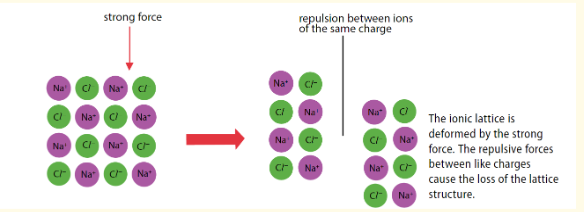
Strong electrostatic forces of attraction between oppositely charged ions - make ionic compounds resistant to deforming
-
Tend to be hard as attractive forces cause ions to resist motion
-
When enough force is applied - ions move away from their lattice positions
-
Ions of same charge approach each other
-
Repulsive forces between ions of the same charge become larger than attractive forces.
-
Ionic crystal lattice structure shatters
In this context, it is force rather than energy.
Ionic compounds: tend to be HARD BUT BRITTLE
Solubility
Most ionic compounds - soluble in water and insoluble in organic solvents When ionic compounds are dissolved in water → we say that they are in aqueous state.
Electrical Conductivity
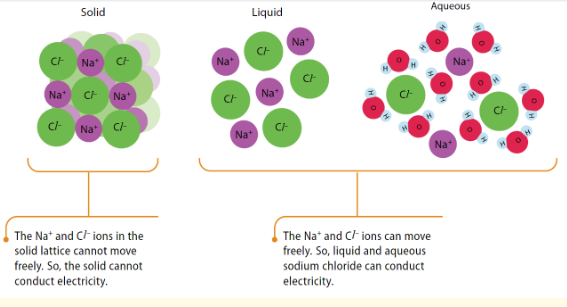
- When ionic compounds in solid state - ions in lattice are only able to vibrate about their fixed positions as they are held in fixed positions.
- Hence ions are not mobile - ions cannot act as charge carriers
When a compound is in molten (liquid) state or aqueous state → ions are mobile and can conduct electricity.
- Ionic compounds - can conduct electricity in molten and aqueous states but not in solid state.
Answering Techniques
Explain in terms of structure when calcium oxide is a solid at R.TP (they are not volatile)
- Calcium oxide is an ionic compound with a 3d giant ionic crystal lattice structure(1)
- In this structure, calcium ions and oxide ions are held together by strong electrostatic forces of attraction (ionic bonds) [1]
- Thus, a lot of energy is required to overcome these strong forces to melt CaO. Thus, CaO has a high melting and boiling point, and it is solid at R.T.P [1]
Explain why calcium oxide is hard
- Calcium oxide is an ionic compound with a 3d giant ionic crystal lattice structure
- In this structure, calcium ions and oxide ions are held together by strong electrostatic forces of attraction (ionic bonds)
- Strong attractive forces cause ions to be resistant to motion.
- Thus, a lot of force is required to overcome the strong electrostatic forces of attraction between calcium and oxide ions. Thus making calcium oxide hard Here, use force instead of energy as you physically apply force rather than energy.
Why us Zinc Bromide in a regular shape
- Zinc bromide is an ionic compound with a 3d giant ionic crystal lattice structure
- Zinc and bromide ions will be held in a repeating pattern, with a large number of alternating positive and negative ions held together which means they are in an orderly arrangement.
- Thus, this shows how it will have a regular shape.
Explain in terms of structure why molten sodium bromide is a good COE
- Sodium ions and bromide ions (Na+ and Br- ) in molten sodium bromide (NaBr) are not held in fixed positions and are freely moving (mobile). Thus, these ions move throughout the substance freely and act as charge carriers.
(type of particles + movement of particles is required in answer)
Explain why Sodium bromide crystals cannot conduct electricity
- Sodium ions and bromide ions (Na+ and Br-) in crystal sodium bromide are held in fixed positions in the 3d giant ionic crystal lattice structure by strong electrostatic forces of attraction
- The Na+ and Br- ions thus vibrate or rotate only about their fixed positions, are not mobile and cannot act as charge carriers.
Explain why sodium nitrate is soluble in water.
- When sodium nitrate is mixed with water, water molecules are attracted to the sodium and nitrate ions
- Forces of attraction between the water molecules and the Na+ and NO3- ions are stronger than the strong electrostatic forces of attraction between Na+ and NO3- ions
- Thus, ions are pulled away from their fixed positions in the 3d giant ionic crystal lattice structure and sodium nitrate dissolves in water to form an aqueous solution. (state what is formed when applicable)**
Explain why magnesium oxide is insoluble in water
- In the 3d giant ionic crystal lattice structure of MgO, magnesium ions and oxide ions are held together by strong electrostatic forces of attraction (ionic bonds) [1]
- These forces are stronger than the forces of attraction between water molecules and Mg2+ and O2- ions.
- Thus, ions remained in fixed positions(state that it is unchanged) in the lattice structure and could not be dissolved in water.
Note: ions act as charge carriers in ionic bonding and not electrons.