Compounds which are good conductors of electricity → when molten / aqueous solution
Electrolytes → are electrolytic conductors→ which decompose → to form new substances → when they conduct electricity
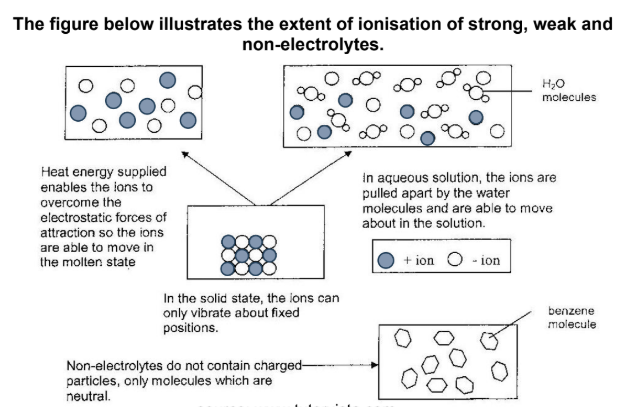
Electricity → can be conducted → due to presence of positive and negative ions (or cations and anions) → which can move freely across molten / aqueous electrolyte → and act as charge carriers
Water soluble covalent compounds → which ionise in water → to produce positive and negative ions (e.g. acids)
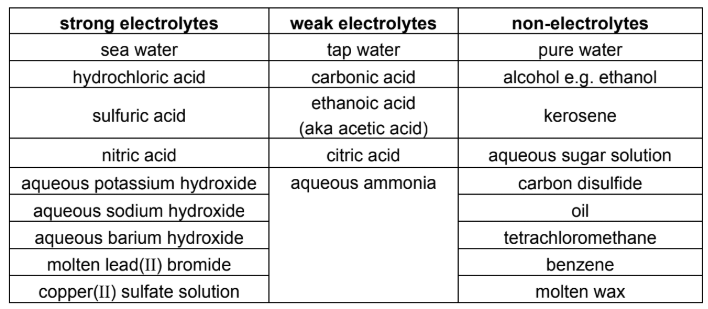
Classification of electrolytes:
Strong Electrolytes:
Compounds that ionise completely / almost completely → to form high concentration of mobile ions → in aqueous solution or molten form
Greater the concentration of mobile ions in electrolyte → the greater is its capacity to carry charges / conduct electricity → the stronger the electrolyte
E.g. - sodium chloride → ionic compound with giant ionic lattice structure → melted or dissolved in water → dissociated completely to form freely moving sodium and chloride ions.
Compounds that ionise partially → form mobile ions in the aqueous solution / molten form
When concentration of mobile ions → lower in electrolyte → lesser is its capacity → carry charges / conduct electricity → the weaker the electrolyte
E.g. - pure ethanoic acid
Covalent compound with the simple molecular structure → when mixed with water → ethanoic acid, being weak acid → ionises partially to form low concentration of hydrogen and ethanoate ions.
Only some of the ethanoic acid molecules ionised → thus concentration of ions (ethanoate and hydrogen) → is less → compared to concentration of ethanoic acid molecules present