Reaction of Acid with an insoluble metal
General Equations: Acid + Alkali → Salt + water Acid + excess metal → Salt + Hydrogen Acid + excess carbonate → Salt + water + Carbon dioxide
metal + acid insoluble metal carbonate + acid insoluble metal oxide + acid insoluble metal hydroxide + acid
Types of salts that can be prepared using this method
- most soluble salts apart from all salts of group 1 metal salts and ammonium salts
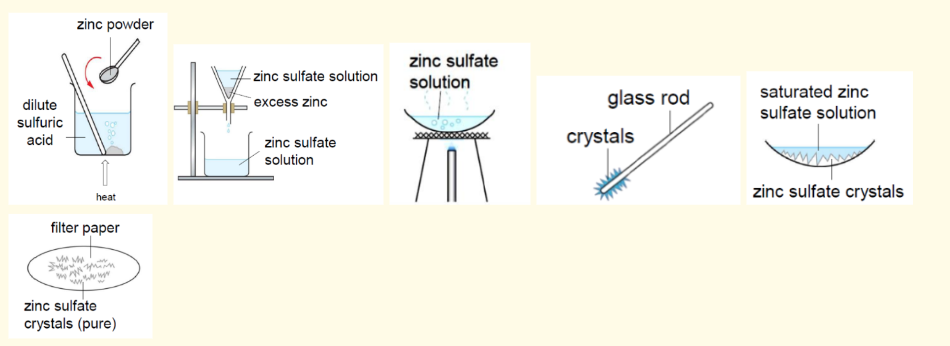
Reaction of acid with reactive metal → usually used to prepare a soluble salt containing a metal ion, like magnesium on or zinc ion.
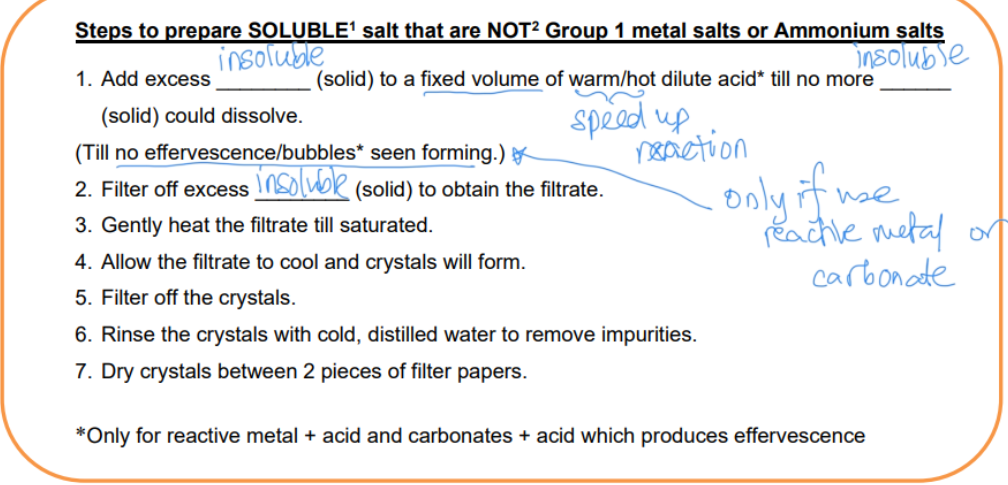
**The Metal, Base, or Carbonate must be in excess:
- so that all the acid is used up (so that the salt solution produced will not be contaminated with the acid)
- filtrate obtained after filtration of reaction mixture is a salt solution that isnt contaminated with unreacted dilute acid.
**The metal, base, carbonate must be in insoluble in water:
- excess starting materials can be removed from the salt solution by filtration.
The metal must be moderately active: if the metal is too active → it will react violently with the acids, causing an extremely dangerous reaction. Refer to Reactivity Series Main Note] → non reactive metals will also not react with the acid, which means that un reactive metals are not suitable for this method. → instead we use a base or carbonate instead.
Reaction of acid with an insoluble base
a) general equation where insoluble base is a metal oxide metal oxide(S) + dilute acid(aq) → Salt(aq) + water(l)
b) general equation where insoluble bases a metal hydroxide Metal hydroxide(s) + dilute acid(aq) → salt(aq) + water(l)
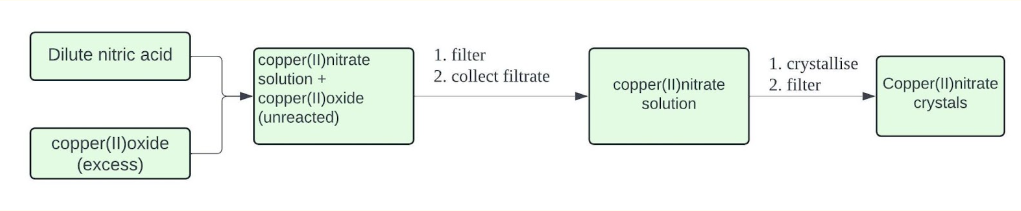
copper(II)nitrate → can be prepared by reacting dilute nitric acid with copper(II)oxide
dilute nitric acid + copper(II)oxide → copper(II)nitrate + water

Reaction of Acid With Insoluble carbonate
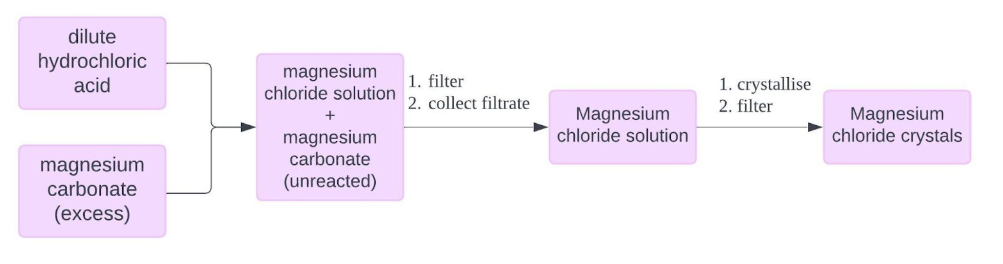
magnesium chloride can be prepared by reacting dilute hydrochloric acid with magnesium carbonate.