ammonia is made industrially by Haber process.
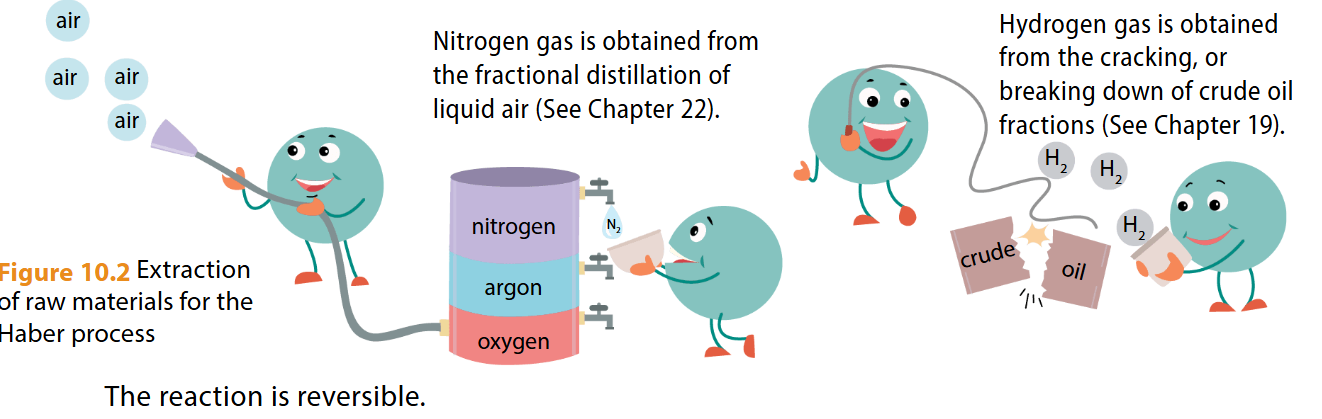
- raw materials are nitrogen and hydrogen
| Reactants | Source(s) |
|---|---|
| nitrogen gas | - nitrogen gas is obtained from fractional distillation of liquified air |
| hydrogen gas | - obtained from cracking of petroleum Producing Alkanes and Alkenes by Cracking - electrolysis of aqueous solutions ElectroChemistry Main Note |
this reaction is reversible
Definition
Reversible reaction can go both forward and backward at the same time #PhysicsDefinitions
Hence some of the ammonia produced → may break down and convert back to nitrogen and hydrogen.
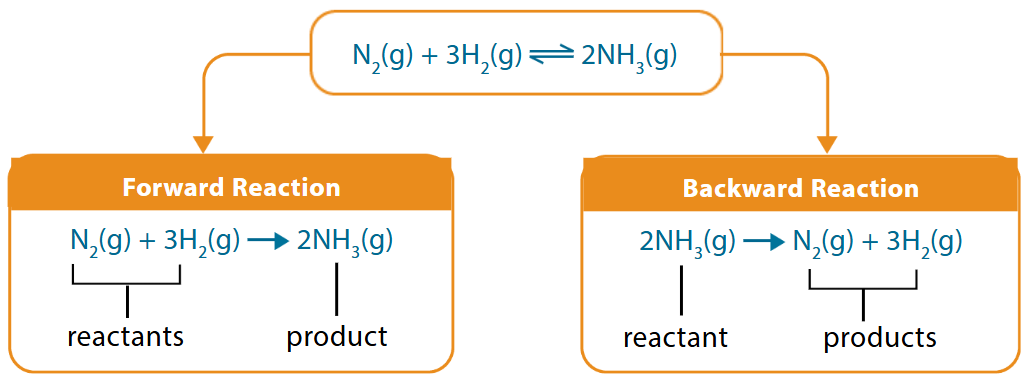
Equation for Haber process is:
Equation
- reaction from left to right → forward reaction
- reaction from right to left → backward reaction
- at r.t.p → nitrogen gas is unreactive
- so the forward reaction does not take place.
- a high pressure and a relatively high temperature are required to start the forward reaction between nitrogen and hydrogen.
- iron is added as a catalyst to speed up the reaction
Because reaction is reversible → some of the ammonia produced → may break down and decompose back into nitrogen and hydrogen.
- therefore → pressure and temperature have to be carefully controlled → so that we can obtain as much ammonia at minimal cost
Important
- forward reaction involves nitrogen gas reacting with hydrogen gas to produce ammonia gas
- backward reactions ammonia gas decomposing to produce nitrogen gas and hydrogen gas.
Important
- Forward reaction is exothermic
- Backward reaction is endothermic
Essential Conditions for Haber Process
Essential Conditions for Haber Process
Optimal Conditions For Haber Process
-
produces maximum yield of ammonia at minimal cost
-
pressure of 250atm
-
temperature of
-
presence of finely divided iron catalyst
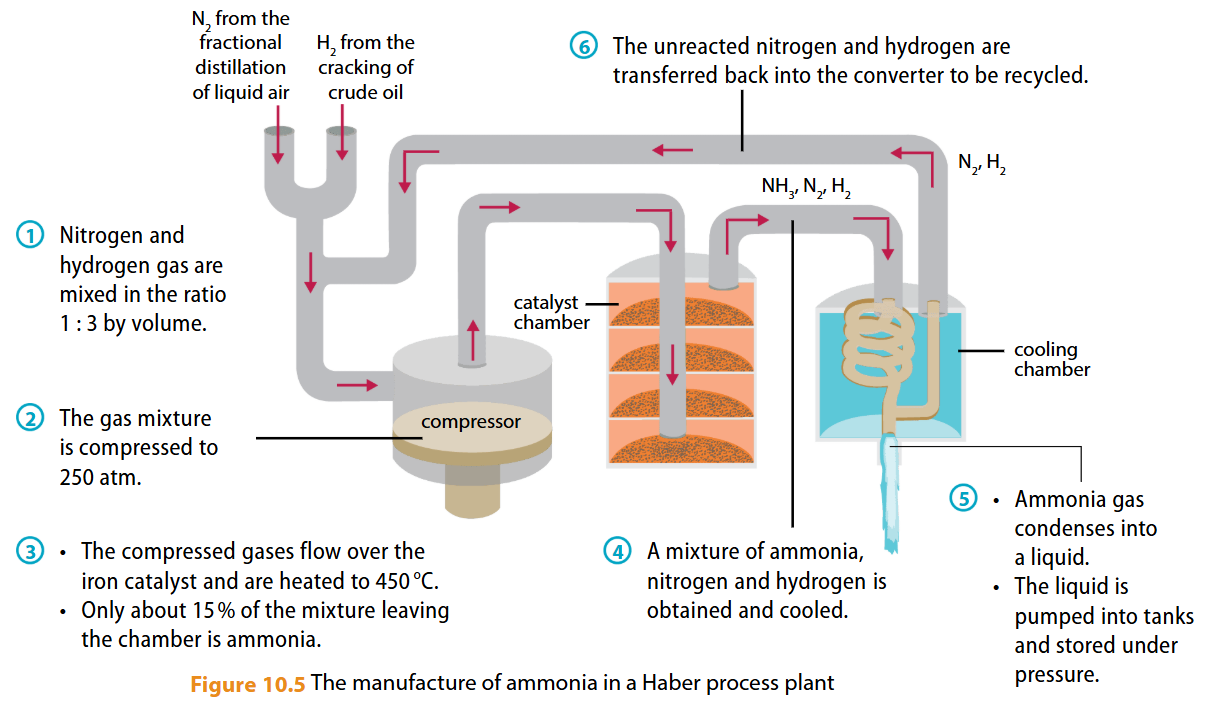
Haber Process Plant
Important
- nitrogen and hydrogen gas are in the ratio 1:3 by volume
- gas mixture compressed to 250atm.
- compressed gases flow over the iron catalyst and are heated to
- only about 15% of the mixture leaving chamber is ammonia
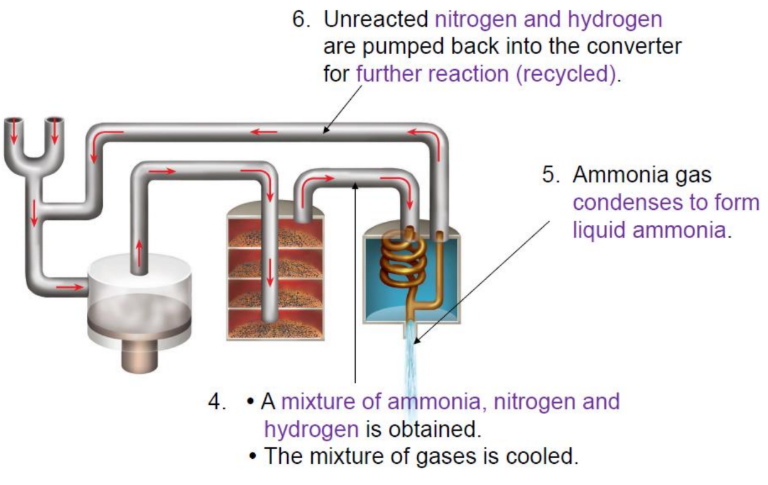
- mixture of ammonia, nitrogen, hydrogen is obtained and cooled
- ammonia gas condenses into a liquid. liquid is pumped into tanks and stored under pressure
- unreacted nitrogen and hydrogen are transferred back to the converter to be recycled (further reaction)
- ammonia gas condenses to form liquid ammonia
- mixture of ammonia, nitrogen and hydrogen is obtained. mixture of gasses is cooled.
Sample
explain why nitrogen gas and hydrogen gases mixed in a 1:3 ratio by volume
- compare mol ratio in balanced chemical equation
- molar volume of all gasses is 24dm3 at r.t.p (MUST STATE)
- this volume ratio is 1:3
Sample
suggest why unreacted nitrogen and hydrogen are recycled for further reaction
- increase yield of
- do not waste reactants (expensive to obtain)
- economically viable.
Sample
when mixture of ammonia, nitrogen and hydrogen gasses are cooled, only ammonia gas condenses to form liquid ammonia.
Suggest how it was achieved in set up:
- control temperature so that temperature should be above boiling point of and but below that of
Importance of Ammonia
Sample
Explain why conditions of and pressure of 200atm
- yield is favoured by low temp, but is chosen so that the rate of reaction will not be too slow such that a long time is needed to obtain the products.
- higher yield is formed by high pressure but pressure of 200atm is chosen so that it isn’t very costly to have pumps that generate high pressure and vessels that can withstand high pressure.