in electrolysis - when more than 1 type of cation / anion → is present in a solution → only one cation and one anion → is preferentially discharged → although both cations and anions would be attracted to cathode and anode respectively.
- this is known as selective discharge of ions
there are more than 1 type of cations/ anions → because can also ionise → and there will be hydrogen ions, and ions from water.
-
so in electrolyte → aqueous sodium chloride → there will be 2 types of cations/positive anions and anions/negative ions.
-
from salt and from water → move towards cathode (negative electrode)
-
from salt and from water → move towards anode (positive electrode) (Unlike molten binary ionic compounds → where this is only 1 type of cation and anion)
- Selective Discharge of Cations
- metal ions of element → lower in reactivity seriesReactivity Series Main Note → are discharged at cathode in preference to other cations in the solution → since less energy is required.
- this is because → cations of less reactive element gain electrons more readily → thus greater tendency to undergo reduction. (position of ions is similar to metal reactivity series)
Summary
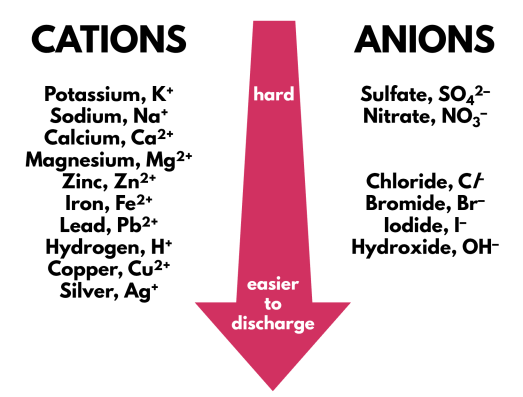
Cation that is selected for discharge →less reactive → has higher tendency to undergo reduction → as it gains electrons more readily → hence is preferentially discharged.
As we go down reactivity series of metals → the ease of discharge of cation increases
Important
metal above hydrogen - hydrogen ions preferentially discharged. vice versa
- Selective Discharge of Anions
-
For electrolytes that are dilute aqueous solutions & concentrated solutions → that do not contain halide ions (negative ions from group 17, Group Properties - Group 17 Elements (Halogens))
-
AKA for solutions that contain sulfate and nitrate ions, regardless of concentration → hydroxide ions will be selectively discharged.
- Usually hydroxide ions ( ) are selected for discharge → in preference to other anions (such as sulfate, nitrate, halide ions etc.) → since less energy is required.
- This is because → hydroxide ions → lose electrons more readily → thus greater tendency to undergo oxidation
-
For electrolytes that are concentrated solutions → that contain halide ions (negative ions from group 17 (Group Properties - Group 17 Elements (Halogens))
- Halide ions are selected for discharge in preference to hydroxide ions → in solution
- This is because → concentration of halide ions → is higher → than concentration of hydroxide ions.
-
For electrolytes that are dilute solutions → that contain halide ions
- hydroxide ions will be selectively discharged in preference to halide ions based on the ease of discharge of anions.
-
In concentrated sodium chloride solution → concentration of is higher than concentration of → as there is plenty of → will be preferentially discharged.
-
In dilute sodium chloride solution → concentration of → is higher than concentration of because there is plenty of water → will be preferentially discharged as it loses electrons more readily → thus greater tendency to undergo oxidation.
-
Sulfates, Nitrates → not discharged → remain in the solution → as more energy is required. they are not affected by concentration, be it high or low.
-
less easily oxidised*
-
polyatomic anions**
Summary
Ease of Discharge of Anions and Cations:
Important
when hydroxide is discharged, this is the standard equation for the products produced.
Note
According to these rules:
- to obtain reactive metals via electrolysis → ionic compounds in molten state need to be used
Electrolysis of Dilute sodium chloride → results in decomposition of water → into components. as water is removed from solution during electrolysis → the concentration of sodium chloride solution increases
- if both hydroxide and oxide are removed, all the time there will be no change in acidity or alkalinity.
- this is due to the balancing between hydrogen and hydroxide ions.
Important
ions are selectively discharged, not the substance itself!