Group Properties - Group 17 Elements (Halogens)
Physical Properties
- Poor conductors of heat and electricity
- Low melting and boiling points
- coloured substances (i.e. not colourless / white)
- Some halogens are soluble in water while others are not
Going down the group → from fluorine to astatine → trends are observed in the physical properties of halogens
- melting and boiling points of halogens increases
- colour of halogens becomes darker
- solubility of halogens in water decreases
| Halogen | Melting Point () | Boiling Point () | Appearance at r.t.p (colour and physical state) | Solubility in water |
|---|---|---|---|---|
| -220 | -188 | Pale yellow Gas | Soluble | |
| -101 | -34 | Green - yellow Gas | Soluble | |
| -7 | 59 | red-brown Liquid | Soluble | |
| 114 | 184 | Purple-Black Solid | Sparingly Insoluble | |
| 302 | 337 | Black Solid | Insoluble |
Chemical Properties
Group 17 elements → called Halogens → they are Diatomic elements → this means that these elements → exist as diatomic molecules which are particles that are made of 2 halogen atoms → chemically combined together
They are reactive non-metals and they react with most metals → to form salts called halides → when halogens react with metals and hydrogen gas → their atoms (which have 7 valence electrons) → gain 1 electron to form negative ions known as halide ions which have a charge of 1-
| Halogen | Name of Halide Ions | Chemical Formula of Halide Ions |
|---|---|---|
| fluoride | F- | |
| chloride | Cl- | |
| bromide | Br- | |
| iodide | I- | |
| astatide | At- | |
Definition
Define reactivity of non-metals:
- Tendency of an atom of non metal to gain one or more electron(s) to form its negative ion.
Hence → atoms of very reactive non-metals → such as halogens → have high tendency to gain electrons to form negative ions (halide ions)
- halogens are powerful oxidising agents Oxidation and Reduction Main Note → in the redox reactions listed below
Note
displacement reaction is a reaction in which one element takes place of another element in the compound.
- displacement reactions of halogens → more reactive halogen displaces a less reactive halogen from its halide compound → to form a halide compound → of the more reactive halogen.
Equation
General word equation: more reactive halogen + compound of less reactive halogen → less reactive halogen + compound of more reactive halogen
Example 1 : Displacement reaction of aqueous bromide with aqueous potassium iodide
Aqueous bromine + potassium Iodide → potassium bromide + aqueous iodine

Sample
What will be observed when displacement reaction → of bromine with aqueous potassium iodide. Explain your reasoning.
- Colourless solution turns dark brown. {1} A black deposit is formed.
- Bromine is a more reactive halogen than iodide{1}
- Thus a displacement reaction will take place.
- Bromine will displace iodine from a colourless solution of aqueous potassium iodide to form a colourless solution of potassium bromide and dark brown solution of iodine. {1} The black deposit is solid iodine as most of the iodine produced is insoluble in water.
Example 2: Aqueous chlorine is added to potassium fluoride solution
Sample
What will be observed when aqueous chlorine is added to potassium fluoride solution? Explain your reasoning
- No visible change is observed {1}
- Chlorine is a less reactive halogen than fluorine {1}
- A displacement reaction will not take place as chlorine cannot displace fluorine from potassium fluoride solution{1}
| Potassium Chloride | Potassium Bromide | Potassium Iodide | |
|---|---|---|---|
| Chlorine | chlorine displaces bromine from a bromide solution. 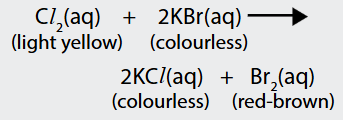 | Chlorine displaces iodine from an iodide solution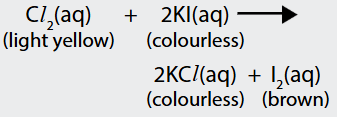 | |
| Bromine | no reaction | Bromine displaces iodine from an iodide solution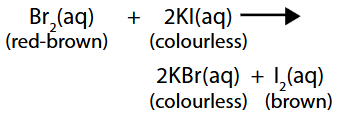 | |
| Iodine | no reaction | no reaction |
- Halogens React with Group 1 Metals to form Metal Halides
Equation
Group 1 metal + halogen → Group 1 metal halide
- Halogens react with Hydrogen Gas to form Hydrogen Halides
Equation
Hydrogen gas + Halogen → Hydrogen Halide
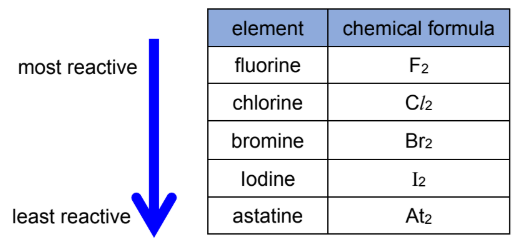
Going down the group → from fluorine to astatine → a trend is observed in the chemical properties of halogens
- we can infer that reactivity of group 17 elements → decreases down the group.
- Chlorine displaces bromine from aqueous potassium bromide, but bromine cannot displace chlorine from potassium chloride solution as chlorine is powerful enough to oxidise KBr but not KF, bromine is powerful enough to oxidise KI but not KCl and KF etc.
 Extension of Learning
- Chlorine displaces bromine from aqueous potassium bromide, but bromine cannot displace chlorine from potassium chloride solution as chlorine is powerful enough to oxidise KBr but not KF, bromine is powerful enough to oxidise KI but not KCl and KF etc.
Note
More reactive halogen will displace less reactive halogen from its halide solution. More reactive halogen has greater tendency to form negative ions compared to a less reactive halogen.
Note
Halogens tend to form diatomic molecules in its natural state