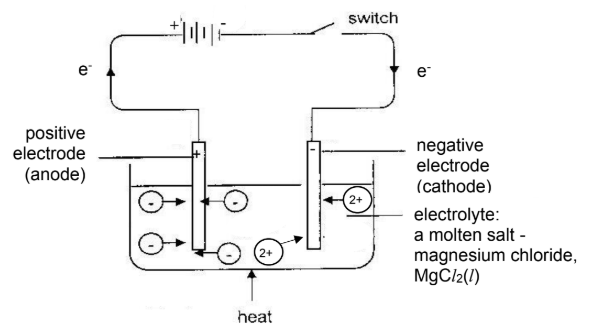
 (diagram of electrolytic cell → that uses graphite/platinum electrodes)
- When switch in external circuit is closed → electrolysis occurs → as battery provided the energy required to drive the process.
During electrolysis:
- In the external circuit → electrons flow from the negative terminal → to the positive terminal of the battery
- At the Positive Electrode (Anode):
- Positive electrode (anode) → attracts negative anions (anions) → in the electrolyte. Thus anions migrate to the positive electrode. Hence positive electrode is known as the anode
- Since positive electrode is an inert electrode → anions will undergo oxidation → by losing electrons
- Anion in → is chloride ion, . Chloride ions → undergo oxidation → by losing electrons → to form chlorine molecules
- Half equation - oxidation at anode (losses of electrons/increase in O.S)
- At Negative Electrode (Cathode):
- Negative electrode (cathode) → attracts positive ions (cations) → in electrolyte. Thus cations migrate to negative electrode. Hence negative electrode → known as Cathode
- Reduction occurs at cathode
- Cations undergo reduction by gaining electrons
- Cation in → magnesium ion, . Magnesium ions undergo reduction → by gaining electrons → form magnesium atoms
- Half equation - reduction at cathode (gain of electrons/decrease in O.S)
- Electrons flow from anode to cathode → through external circuit.
Important
Electrons DO NOT flow through electrolyte but through the wire → as the resistance in the wire → is lower compared to resistance in the electrolyte D.C. Circuits Main Note Practical Electricity Main Note
electrolyte will conduct the electricity to form a closed circuit via the ions*
Summary
Oxidation occurs at anode Reduction occurs at cathode
Electrolysis of Molten Ionic Compounds Using Inert Electrodes Electrolysis of Aqueous Solutions Using Inert Electrodes