Definition
Organic Compounds are pure substances whose molecules are made up of 1 or more carbon atoms that are covalently bonded to other elements, most commonly hydrogen, oxygen, chlorine or nitrogen #ChemistryDefinitions
→ these compounds can be obtained from natural or artificial sources. e.g. citric acid found in citrus fruits is a carboxylic acid.
Understanding
organic chemistry is a branch of chemistry related to the study of structure, properties, reactions and preparation of organic compounds. in the study of organic compounds, it is important to classify the many compounds according to their similarities.
Homologous Series
Alkanes
Alkenes
Producing Alkanes and Alkenes by Cracking
Producing Alkanes and Alkenes by Cracking
Isomers
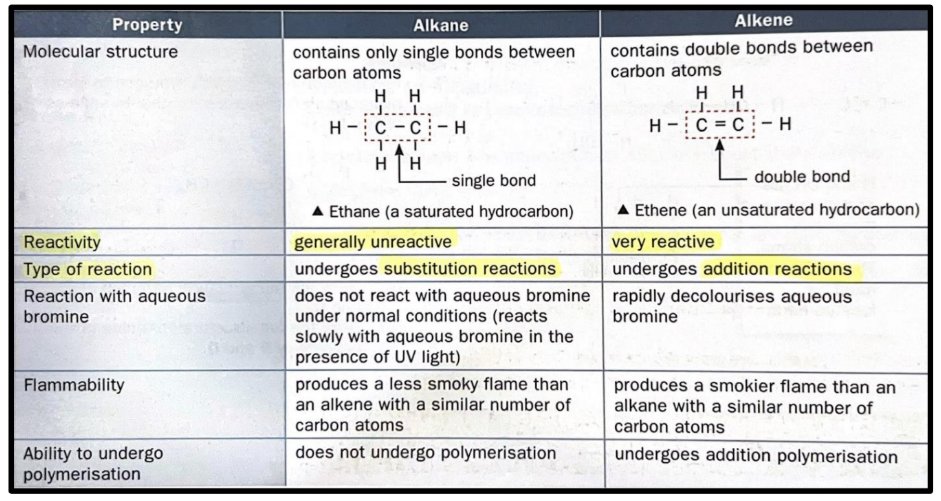
Diff Between Saturated and Unsaturated Compounds
Diff Between Saturated and Unsaturated Compounds
| Feature | Saturated Hydrocarbons | Unsaturated Hydrocarbons |
|---|---|---|
| Type of bonds | Only single bonds between carbon atoms | At least one double or triple bond between carbon atoms |
| Example | Alkanes | Alkenes |
| Reactivity | less reactive | more reactive |
| Main type of reaction | Substitution, combustion | combustion, addition |
| Test with bromine water (bromine solution) | no change | decolourises |
| Saturation | fully saturated with hydrogen | not fully saturated with hydrogen |
 |
Sample
short chain alkenes/alkanes → have 1-4 carbon atoms (ish)
- they are usually in gaseous state
Important
unsaturated only refers to 1 or more carbon-carbon double bonds, there is no relation to double bonds between any other molecules
Important
every time you introduce a new double bond, must lose 2 hydrogen
represent anion first for organic
Important
tetra is used for something with 4 …