- Reaction of acid with reactive metal ⇒ example of redox reaction while neutralization and precipitation are non-redox reactions
Definition of redox reactions
Definition
Chemical reaction where oxidation and reduction occurs simultaneously #ChemistryDefinitions
Oxidation and Reduction are chemical reactions
- in a redox reaction ⇒ reactants are the substances which undergo oxidation and reduction
- Reactants which undergo oxidation are said to be oxidized
- reactants which undergo reduction are said to be reduced
Definition of Oxidation and Reduction
| Oxidation | Reduction |
|---|---|
| 1. Gain of | 1. Loss of |
| 2. Loss of Hydrogen | 2. Gain of Hydrogen |
| 3. Loss of Electrons | 3. Gains of Electrons |
| 4. Increase in Oxidation state | 4. Decrease in Oxidation State |
Oxidation and Reduction as Gain and Loss of Electrons
Oxidation — Gain of Oxygen
- term oxidation can be used to describe reaction ⇒ in which oxygen combined with an element or compound (reactant) to form another substance (product). Reactant is said to be oxidized. ChemistryDefinitions
Reduction — Loss of Oxygen
- reduction is the reverse of oxidation. term reduction ⇒ can be used to describe a reaction in which oxygen is removed from compound (reactant) to form another substance (product). Reactant is said to be reduced. ChemistryDefinitions
Example: Reaction of metal oxides → Eg: Copper(II)oxide with hydrogen gas to form pure metal (example, copper)
when mixture of copper(II)oxide and hydrogen gas is heated ⇒ redox reaction occurs.
Equation for this reaction is:
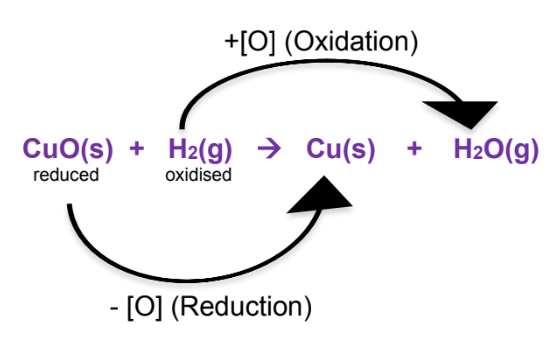
Explain in terms of oxygen, why the reaction between copper(II)oxide and hydrogen gas is a redox reaction.
-
Hydrogen gas () has gained oxygen from copper(II)oxide (CuO) to form ()
-
Hydrogen gas () is oxidized. OR hydrogen gas () has undergone oxidation
-
Copper(II)oxide⇒ CuO ⇒ lost to hydrogen gas () to form copper (Cu)
-
Copper(II)oxide (CuO) ⇒ reduced. OR copper(II)oxide (CuO) undergone reduction.
Since oxidation and reduction occur at the same time ⇒ redox reaction.
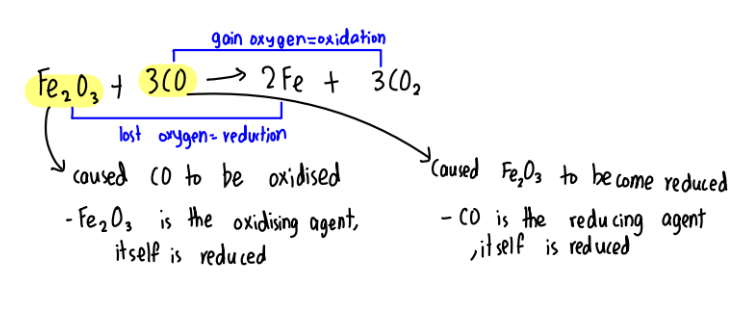
Oxidizing and Reducing Agents — Gain and Loss of Oxygen
Oxidizing Agent (aka Oxidant):
- substance that causes another substance (reactant) to undergo oxidation
- Substance (reactant) that loses oxygen to another substance (another reactant), itself undergoing reduction. ChemistryDefinitions
Reducing Agent (aka reductant)
- A substance that causes another substance (reactant) to undergo reduction
- substance (reactant) that gains oxygen from another substance (another reactant) itself undergoing oxidation ChemistryDefinitions
Explain reaction in metal oxides (for example copper(II)oxide) with hydrogen gas to form pure metal (for example, copper)
when mixture of copper(II)oxide and hydrogen gas is heated a redox reaction occurs:
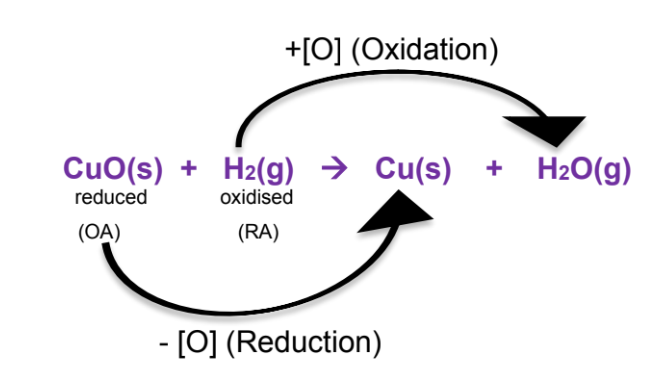 identify the oxidizing and reducing agents in this reaction. Explain your answer in terms of oxygen
-
Copper(II)oxide (CuO) is an oxidizing agent
-
Copper(II)oxide (CuO) caused hydrogen gas () to be oxidized to water () by losing oxygen to hydrogen gas ()
-
Hydrogen gas () is a reducing agent
-
Hydrogen gas () caused copper(II)oxide (CuO) ⇒ to be reduced to copper(Cu) by gaining oxygen from copper(II)oxide (CuO)
Oxidation and Reduction as Gain and Loss of Hydrogen
Oxidation — Loss of Hydrogen Term oxidation ⇒ can be used to describe a reaction in which hydrogen is removed from a compound (reactant) to form another substance (product). Reactant is said to be oxidised
Reduction — Gain of Hydrogen Reduction ⇒ reverse of oxidation. Reduction can be used to describe a reaction in which hydrogen combined with an element or compound (reactant) to form another substance (product). Reactant is said to be reduced.
Example: Reaction of Hydrogen Sulfide with Chlorine
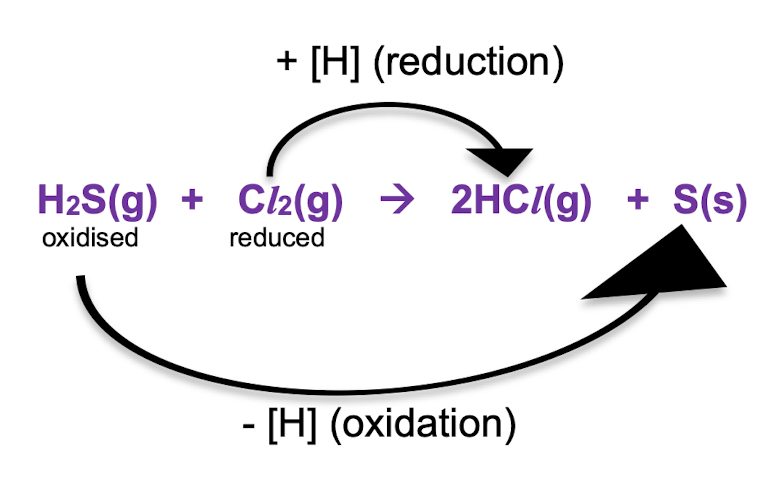
Explain in terms of hydrogen, why this is a redox reaction
-
hydrogen sulfide () has lost hydrogen to chlorine gas () to form sulfur (S)
-
Hydrogen sulfide is oxidised. OR hydrogen sulfide has undergone oxidation
-
chlorine () has gained hydrogen from hydrogen sulfide () to form hydrogen chloride ()
-
chlorine () is reduced. OR chlorine () has undergone reduction
since oxidation and reduction occur at the same time, this is a redox reaction
Oxidising and Reducing Agents — Gain and Loss of Hydrogen
Oxidising Agent (aka Oxidant)
- substanec that causes another substance (reactant) to undergo oxidation
- substance (reactant) that gains hydrogen from another substance (another reactant) itself undergoing reduction
Reducing Agent (aka Reductant)
- Substance that causes another substance (reactant) to undergo reduction
- a substance (reactant) that loses hydrogen to another substance(another reactant) itself undergoing reduction
example: reaction of hydrogen sulfide with chlorine
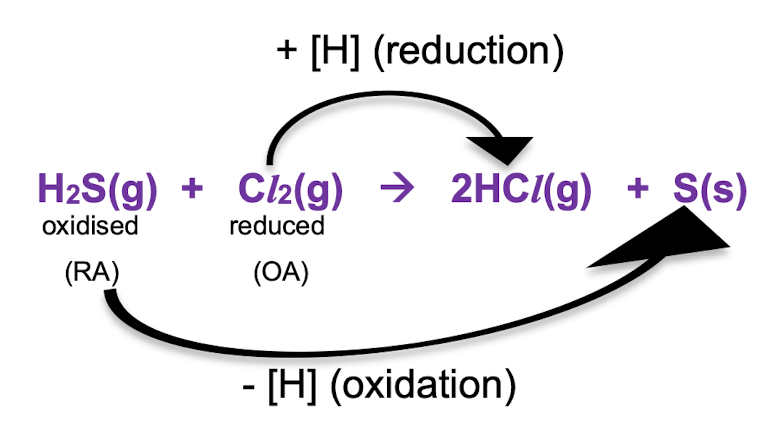
Identify oxidizing and reducing agents in this reaction. Explain your reasoning in terms of hydrogen
-
Chlorine () is an oxidizing agent
-
Chlorine () causes hydrogen sulfide () to be oxidized to sulfur (S) by gaining hydrogen form hydrogen sulfide ()
-
Hydrogen sulphide () is a reducing agent
-
Hydrogen sulphide () caused chlorine () to be reduced to hydrogen chloride (HCl) by losing hydrogen to chlorine (
Oxidation and Reduction as Gain and loss of Electrons (Electron Transfer)
Oxidation ⇒ loss of electrons term oxidation can be used to describe reaction in which a reactant loses electrons to form a substance (product). Reactant is said to be oxidized
Reduction ⇒ Gain of Electrons Reduction is the reverse of oxidation. Term reduction can be used to describe a reaction in which a reactant gains electrons to form a substrate (product). Reactant is said to be reduced
Example: Displacement reaction of Halogens (Group 17 Elements)
- in a displacement reaction of Halogens, more reactive halogen will replace a less reactive halogen from its salt solution
- This reaction happens because a more reactive halogen ⇒ has greater tendency to accept electrons to form its negative ions(anions) than the less reactive halogen.
Reactivity Series Main Note Group Properties - Group 17 Elements (Halogens)
When aqueous chlorine is added to a beaker of aqueous sodium bromide, following reaction occurs:
 Sodium chloride and aqueous bromine are products of this displacement reaction
Explain why this is a redox reaction in terms of electron transfer
| Step | Elaboration |
|---|---|
| Step 1: Write Ionic Equation for this reaction | 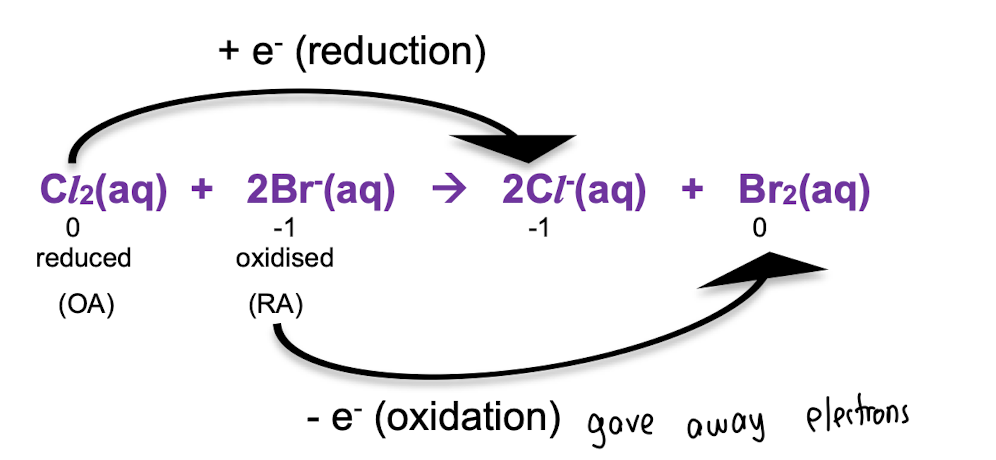 |
| Step 2: Write Half-equation for oxidation | Bromide ions () in sodium bromide (NaBr) have lost electrons to chlorine () to form bromine (Br). Thus, bromide ions () have been oxidised. Hence, aqueous sodium bromide (NaBr) is oxidised |
| Step 3: Write half equation for reduction | Aqueous chlorine () gained electrons from bromide ions () in sodium bromide (NaBr) to form chloride ions () in sodium chloride (NaCl). Hence aqueous chlorine () is reduced. since oxidation and reduction occur at the same time, this is a redox reaction |
| For half equations, refer to Writing Half Equations |
Oxidising and Reducing Agents - Gain and loss of Electrons
Oxidising Agent (oxidant)
- substance that causes another substance (reactant) to undergo oxidation
- Substance (reactant) that gains electrons from another substance (another reactant) itself undergoes reduction
Reducing Agent (reductant)
- substance that causes another substance (reactant) to undergo reduction
- substance (reactant) that loses electrons to another substance (another reactant), itself undergoes oxidation
Example: Displacement Reactions of Halogens, (Group 17 Elements) ⇒ when aqueous chlorine is added to a beaker of aqueous sodium bromide, following displacement reaction occurs:
Identity the oxidising and reducing agents in this reaction. Explain your reasoning in terms of electron transfer
| Step | Elaboration |
|---|---|
| step 1: write ionic equation for this reaction | 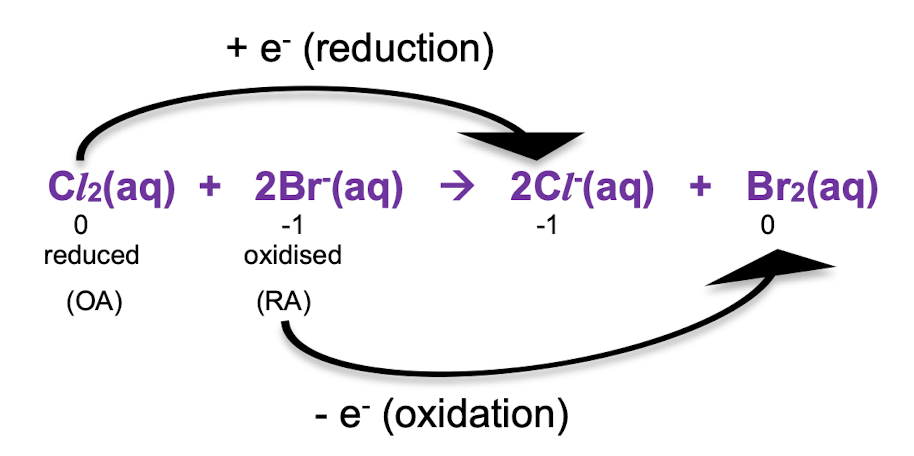 |
| Step 2 | Aqueous chlorine is an oxidising agent. half equation for oxidation of bromide ions: aqueous chlorine () caused bromide ions () in aqueous sodium bromide (NaBr) to be oxidised to bromine () by gaining electrons from bromide ions () |
| step 3 | Aqueous sodium bromide is a reducing agent. half equation for reduction of aqueous chlorine: aqueous sodium bromide (NaBr) caused aqueous chlorine () to be reduced to chloride ions () in aqueous sodium chloride (NaCl) by losing electrons to aqueous chlorine () |
What is Oxidation State
Definition
oxidation state is a number assigned to an element, as though the compound is an ionic compound. ChemistryDefinitions
important note:
- regardless of the type of bonding (covalent or ionic) that exists in the compound, to work out the oxidation state of an atom of an element, assume atom of element exists as an ion
| Rule | Involves | Oxidation State | Remarks |
|---|---|---|---|
| Rule 0 (All elements) | atoms of the same element, such as: - single atoms - molecules of an element - metallic elements | 0 | atoms of same element have no net charge |
| Rule 1 (groups 1 and 2) | a) group 1 elements in their compounds b) group 2 elements in their compounds | +1 +2 | Atoms from group 1⇒ lose an electron atoms from group 2 ⇒ lose 2 electrons |
| Rule 2: (special non metals) | a) fluorine in its compounds (always) b) hydrogen in its compounds (usually) c) oxygen in its compounds (usually) | -1 +1 -2 | Fluorine ⇒ most reactive non metal and attracts electrons to itself strongly. → its oxidation state is always -1, as in Hydrogen ⇒ non metal ⇒ usually has oxidation state of +1. when it forms compounds with metals, it will have oxidation state of -1. Oxygen, after fluorine ⇒ is next most likely to gain electrons. usually has oxidation state -2. In peroxides, oxidation state is -1. |
| Rule 3: (groups 13-17) | Elements from groups 13-17 in their compounds a) metallic elements b) non metallic elements and metalloids | often based on most common valency almost always positive may be negative or positive | A compound has no net charge, so that oxidation states of the atoms in that compound will add up to 0. ion has a positive or negative charge, so the oxidation states will add up to that charge |
| Rule 4: (groups 3-12) | Elements from groups 3-12in their compounds, and elements with proton numbers 57-71 or 89-103 | Always positive | Elements in groups 3-12 ⇒ can have different oxidation states in their compounds. Roman numerals ⇒ indicate oxidation state present in the named species. |
| ![[Screenshot 2024-09-11 at 10.05.28 AM.png | 400]] |
Example 1: How to determine oxidation state (O.S) of chlorine in perchloric acid
- step 1: state the correct chemical formula of perchloric acid:
- Step 2: let y represent oxidation state of chlorine in perchloric acid
- Step 3: recall that overall oxidation state of a compound is 0 Hence overall oxidation state of perchloric acid = 0. (no. of atoms of H O.S of H) + (no. of atoms of Cl O.S of chlorine) + (no. of atoms of O O.S of O) = 0 1 (+1) + 1 (y) = 4 (-2) = 0 y = +7 (Must include sign for oxidation state)
Oxidation and Reduction as Increase and Decrease in Oxidation State
Oxidation — Increase in Oxidation State Term oxidation ⇒ can be used to describe a reaction in which reactant loses electrons to form a substance (product). When the reactant loses electrons, its oxidation state increases. Reactant is said to be oxidised.
Reduction — Decrease in Oxidation State Reduction is the reverse of oxidation. term reduction can be used to describe a reaction in which reactant gains electrons to form a substance (product). When the reactant gains electrons, oxidation state decreases. Reactant is said to be reduced
Example 1: Reacting Copper with oxygen to form Copper(II)Oxide
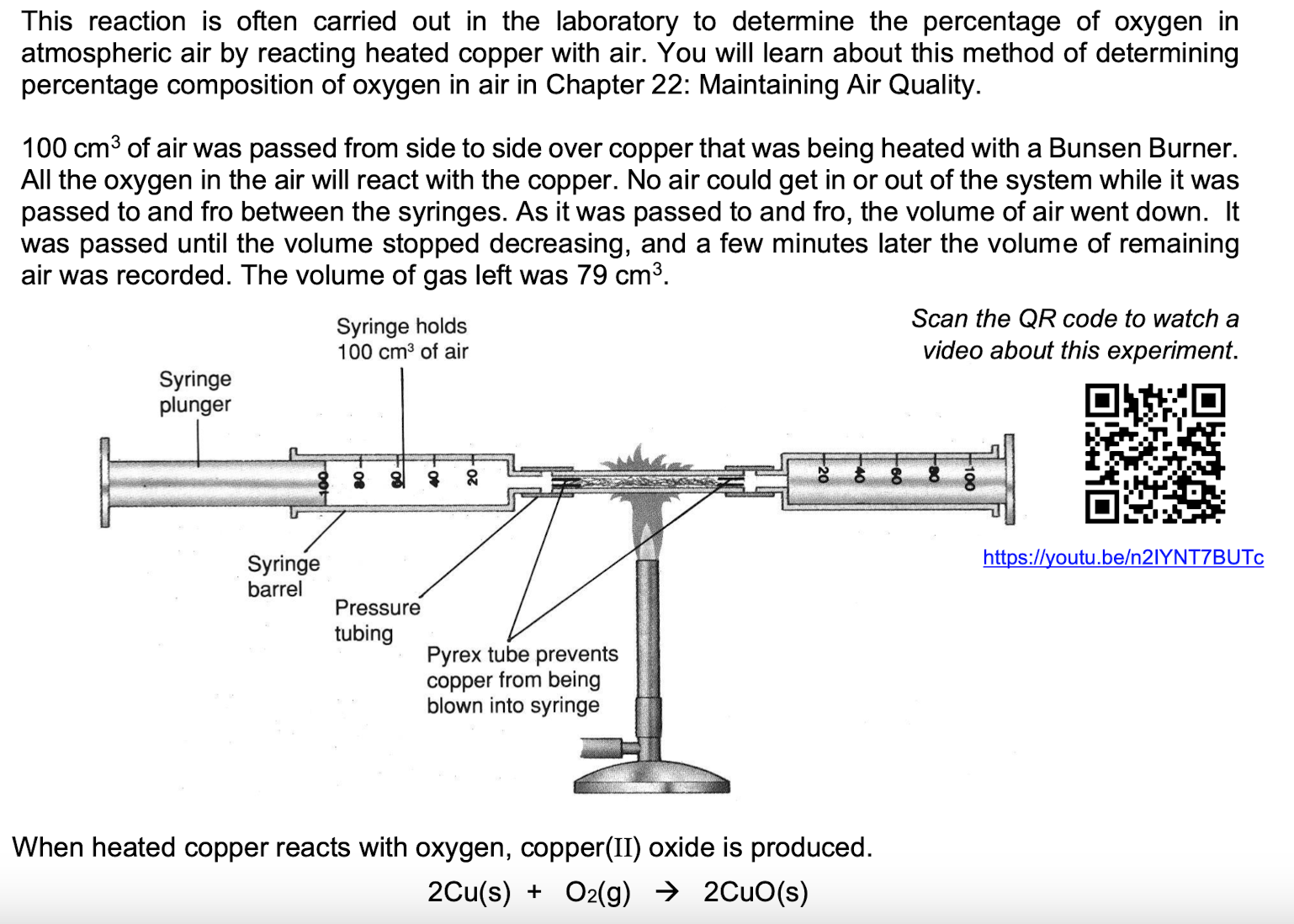 Explain in terms of oxidation states, why reaction between copper and oxygen is a redox reaction
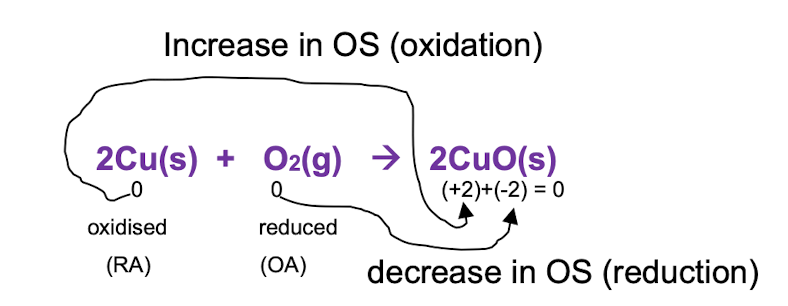
- oxidation state of copper increases from 0 in copper metal (Cu) to +2 in copper(II)oxide (CuO). Copper Metal (Cu) is oxidised. OR copper metal undergoes oxidation
- oxidation state of oxygen decreases from 0 in oxygen gas () to -2 in copper(II)oxide (CuO). Oxygen gas () is reduced. OR oxygen as () undergoes reduction
- Since oxidation and reduction occurs at the same time, hence it is a redox reaction
Example 2: Aqueous calcium hydroxide neutralises Hydrochloric acid to produce an aqueous solution of calcium chloride
is the reaction between aqueous calcium hydroxide and hydrochloric acid a redox reaction. Explain your reasoning in terms of oxidation states
| Elements | Calcium | Oxygen | Hydrogen | Chlorine |
|---|---|---|---|---|
| Oxidation state in reactants | +2 | -2 | +1 | -1 |
| Oxidation state in products | +2 | -2 | +1 | -1 |
| No. as oxidation state for all elements in reactants are same as in products, there is no change in oxidation state. | ||||
| Thus this is a non redox reaction |
Examples of Non redox reactions
- Neutralization
- Thermal Decomposition
- Precipitation
Oxidizing and Reducing Agents — Increase and Decrease in Oxidation State
Oxidizing Agent (oxidant)
- substance that causes another substance (reactant) to undergo oxidation
- substance (reactant) that causes oxidation state of another reactant to increase, itself undergoes reduction
Reducing Agent (reductant)
- substance that causes another substance (reactant) to undergo reduction
- Substance (reactant) that causes oxidation state of another reactant to decrease, itself undergoes oxidation
Example 1: reacting copper with oxygen to form copper(II)oxide copper is heated in air ⇒ copper reacts with and copper(II)oxide is produced:
identify oxidizing and reducing agents in this reaction
Explain your reasoning in terms of oxidation states
-
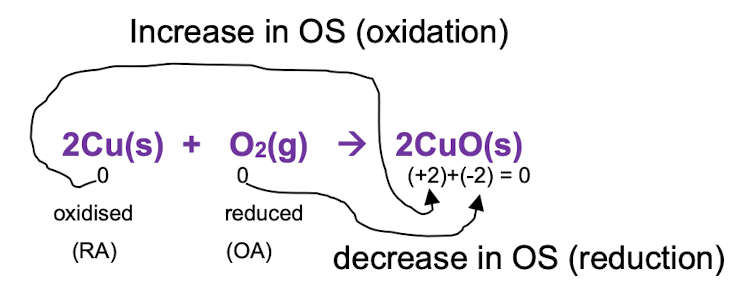
is an oxidizing agent
-
caused copper metal (Cu) to be oxidized to copper(II)oxide (CuO) by increasing oxidation state of copper from 0 in Cu to +2 in CuO
-
Copper (Cu) is a reducing agent
-
Copper (Cu) caused oxygen () to be reduced to copper(II)oxide (CuO) by decreasing oxidation state of oxygen from 0 in oxygen () to -2 in copper(II)oxide (CuO)
Oxidizing Agents and Reducing agents
Oxidation Agent (Oxidant)
| Examples of Oxidising Agents | Connection to other topics |
|---|---|
| Halogens (, ) | Chapter 14; Displacement reactions of halogens |
| Oxygen gas in air () | Chapter 15; Rusting of iron Chapter 20: atmospheric oxidation of alcohol to produce carboxylic acid |
| Hydrogen peroxide () | chapter 17; Decomposition of hydrogen peroxide |
| Acidified potassium manganate (VII) ( | Chapter 11; Test for sulfur dioxide gas Chapter 12: testing for reducing agents Chapter 20: Oxidation of alcohol to produce carboxylic acid |
| Acidified potassium dichromate (VII) () | Chapter 12: test for sulfur dioxide gas Chapter 13: testing for reducing agents |
| → not tested** |
Reducing Agent (aka Reductant)
- substance that causes another substance (reactant) to undergo reduction
| Examples of Reducing Agents | Connection to other Topics |
|---|---|
| Reactive metals (eg; Na, K, Zn, Fe) | Chapter 8/15: Chemical properties of metals Chapter 14: Chemical properties of group1 alkali metals |
| Hydrogen gas () | chapter 8/15: chemical properties of compounds of metals (reaction with metal oxides) |
| Carbon (C) | chapter 15: extraction of metals from their ores |
| Carbon monoxide (CO) | old syllabus; extraction of metals from their ores |
| hydrogen peroxide () | chapter 17; decomposition of hydrogen peroxide |
| aqueous potassium iodide (KI) | chapter 12; testing for oxidizing agents chapter 12/14: displacement reactions of halogens |
| Sulfur dioxide () | chapter 11: test for sulfur dioxide gas |
Testing for Oxidizing and Reducing Agents
| Test for Oxidizing Agents | Test for Reducing Agents | |
|---|---|---|
| Reagent used for the test | aqueous potassium iodide (KI) (a reducing agent) | Acidified potassium manganate (VII) solution. (oxidizing agent) |
| initial appearance of reagent | colorless solution | purple solution |
| procedure | add a few drops of aqueous potassium iodide to a solution containing an oxidizing agent | Add a few drops of acidified potassium manganate (VII) solution to a solution containing a reducing agent. OR add equal volumes of dilute sulfuric acid and potassium manganate (VII solution to a solution containing a reducing agent |
| observation | Colorless aqueous potassium iodide turns brown | purple acidified potassium manganate (VII) solution is decolorized (or turns colorless) |
| explanation for observation | -1 0 When Kl(aq) is added to oxidizing agent, oxidizing agent caused colorless solution of iodide ions () to be oxidized to brown aqueous iodine by increasing the oxidation state of iodine from -1 in to 0 in |  when acidified is added to a reducing agent, reducing agent caused purple solution of manganate (VII) ions () to be reduced to a colorless solution of manganese(II) ion () by decreasing the oxidation state of manganese from + 7 in to +2 in |