Note
Key Concepts to consider for reactions involving compounds of metals
the greater the tendency for metal to lose electrons to form its positive ions achieve stable electronic configuration of noble gas → the more reactive the metal. → thus a more reactive metal has a greater tendency to undergo reactions to form compounds than a less reactive metal. → in the compound of a reactive metal → the metal ions have stable electronic configuration of noble gas. → thus these ions do not take part in further chemical reactions readily.
Hence → more reactive a metal is → the more stable the compounds of a metal to chemical reactions → thus the lower the tendency of these compounds to undergo chemical reactions. → the less reactive a metal is → the less stable the compounds of a metal to chemical reactions → thus the higher the tendency for these compounds to undergo chemical reactions.
Important
Displacement reactions are generally exothermic
Displacement reactions of metals (redox reactions)
Definition
Displacement reaction of metal: Chemical change where a more reactive metal displaces a less reactive metal from a compound of the less reactive metal.
Note
More reactive metal can displace less reactive metal from its salt solution
Note
In metal displacement reaction → more reactive metal is oxidised, while less reactive metal is reduced. Thus, displacement reaction is redox. Oxidation and Reduction Main Note
General Equation of Displacement Reaction of Metals
Equation
More reactive metal + compound of less reactive metal → less reactive metal + compound of more reactive metal. AB + C → A + CB
General Ionic Equation of Displacement Reactions of Metals
Equation
Atom of more reactive metal + cation of less reactive metal → atom of less reactive metal + cation of more reactive metal
Sample
Use reactivity series of Metals and the concept of redox to explain how displacement reactions of metals work
- Atoms of more reactive metal are oxidised to form form cations (positive ions) by losing electrons to the cations of less reactive metal in the compound.
- Cations of less reactive metal in the compound are reduced to form atoms by gaining electrons from atom of more reactive metal.
There are 2 types of Displacement reactions of metals:
1. Reactions of Reactive Metals with Aqueous solutions of salts (contains Cations of less reactive metals)
Equation
More reactive metal (s) + salt of less reactive metal (aq) → less reactive metal (s) + salt of more reactive metal (aq)
2. Reactions of more reactive metals with oxides of less reactive metals. This type of reaction is also known as Thermite Reaction
Equation
More reactive metal + oxide of less reactive metal → less reactive metal + oxide of more reactive metal (include state symbols) >Known as Thermite Reaction
Metals → which are higher up in reactivity series → are more reactive than metals lower down in the series.
- Thus a metal which is higher up in reactivity series can displace a metal below it either
- I) from its salt solutions
- Ii) from its oxide
Thus Order of reactivity of given set of metals (and hence the position in the reactivity series) can also be determined from the observations of these reactions
When displacement reaction takes place → colour change is observed When displacement reaction does not take place → colour change is not observed There is no visible change (or no observable change)
To predict observations of a displacement reaction accurately → we need to know colour of metals and their ions in various physical states. Colour of Metals and their ions in various physical states
Comparing Reactivity Of Metals using Displacement Reactions
i) A more reactive metal displaces a less reactive metal from its salt solution
Example:
When magnesium is placed in beaker of copper (II) sulfate solution → chemical change occurred
Describe what was observed. Write an equation for chemical change which has occurred and explain the observations.
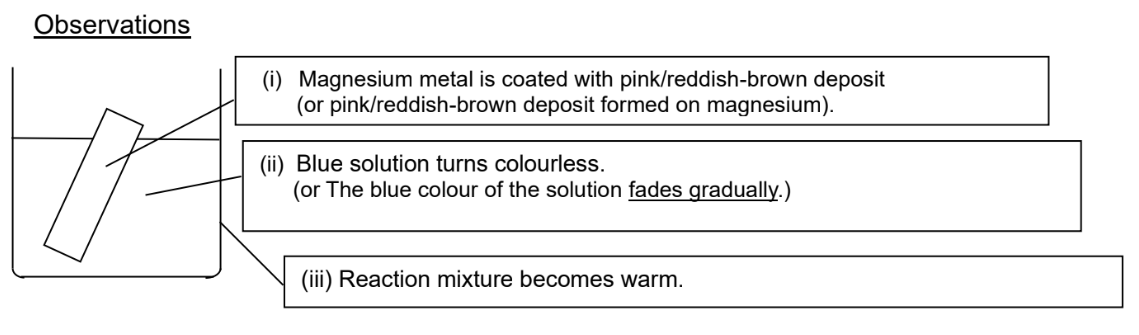

Explanation Magnesium → is a more reactive metal than copper as magnesium loses electrons to form its positive ions more readily.
- Thus, displacement reaction will take place between Mg and
- Magnesium displaces copper from blue copper (II) sulfate solution → to form colourless magnesium sulfate solution and copper which is the pink deposit.
- Blue colour of copper (II) sulfate solution → fades gradually → as the concentration of copper (II) ions in the reaction mixture decreases as reaction progresses.
As displacement reactions are Exothermic → thus reaction gives out heat to the surroundings → causing reaction mixture to become warm.
Sample
always do your best to state colour of reactants and products for accuracy in your answer!
ii) A reactive metal is unable to displace a more reactive metal from its salt solution
Example: When copper is placed in a beaker of magnesium sulfate solution.
Observation: No visible change is observed. (or there is no observable change)
Explanation: Copper is less reactive than magnesium as copper loses electrons to form its positive ions less readily. → Thus displacement reaction did not take place as copper cannot displace magnesium from magnesium sulfate solution.
iii) More reactive metal can reduce the oxide of a less reactive metal. This chemical change is known as thermite reaction
Example
In the following set up → zinc reacted with copper (II) oxide → to produce a reddish brown solid.
→ this reaction gives out a lot of light energy and heat.
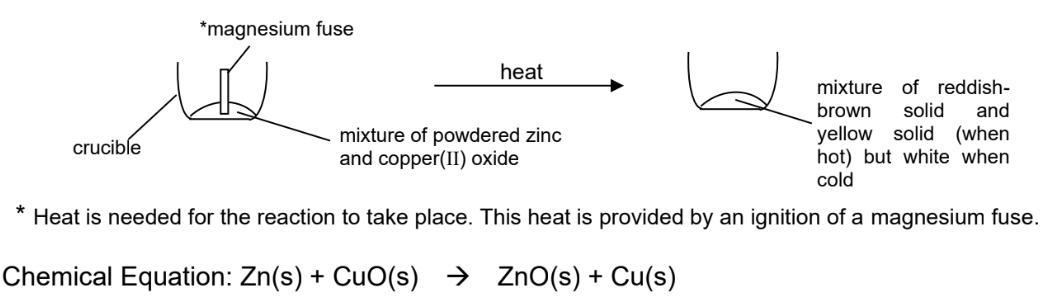
Explanation Zinc is a more reactive metal than copper → as zinc loses electrons to form its positive ions more readily. → thus a redox reaction will take place between Zn and CuO When heated → zinc reduces copper (II) oxide → to form reddish brown solid of copper and is itself oxidised to form yellow solid of zinc oxide Yellow solid of zinc oxide → turns white on cooling to r.t.p as thermite reactions are highly exothermic → thus this reaction gives out a lot of energy in the form of heat and light to the surroundings.
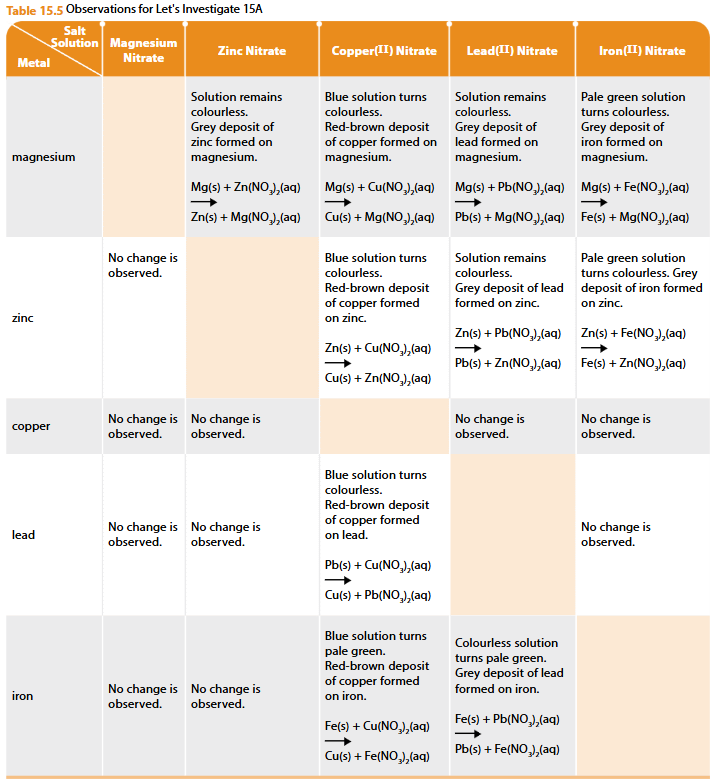
- Metal higher up reactivity series → will displace a metal lower in series from its salt solution
Sample
Answer format for displacement:
- which one is more/less reactive and why → greater/lower tendency to gain/lose electrons
- thus displacement reaction takes place/does not take place between x and y
- explain displacement of ions, include colour changes -explain gradual fading due to decrease/increase in concentration of certain ion
IF required: exothermic + heat given out